What causes a musty closet smell in a Miami home
A closet that smells damp when you open the door is telling you something. In Miami, that smell almost always comes from moisture the closet cannot get rid of, and the fix starts with finding where it comes from.
Written from what our crews see on Miami jobs, for homeowners, condo owners and property managers.
At a glance
- Written by
- Winston Albright
- Role
- Guides Editor and Restoration Project Lead
- Updated
- November 2026
- Reading time
- 6 minutes
- A musty closet smell usually means mold or mildew is growing somewhere you cannot see yet.
- Miami humidity and still closet air can cause it alone, but a hidden leak is often behind it.
- Shared walls with bathrooms, laundry rooms and AC closets are the first places to check.
- Fix the moisture source first; air fresheners and paint only cover the problem.
What the musty smell actually is
That earthy, stale odor is mostly gases released by mold and mildew as they grow. You can smell it well before you see any spots, because the growth often starts on the back of drywall, under shelving or on items packed tight against a wall.
So a musty closet is rarely just a smell problem. It is a moisture problem that has been going on long enough for something to start growing. Air fresheners, cedar blocks and scented sachets can hide the odor for a while, but the cause keeps going underneath.
The EPA puts it plainly: the key to mold control is moisture control, because mold cannot grow without moisture. Every fix below comes back to that idea. The CDC also notes that some people react to mold with a stuffy nose, coughing, wheezing or itchy eyes, so a closet that smells musty is worth dealing with, not just living with.
Miami humidity and still air
Closets are small, dark and closed most of the day. Air barely moves inside them, and many have no supply vent at all. Average relative humidity in Miami runs about 82 percent in the morning across the year, and the National Weather Service notes dew points in the 70s are an almost daily occurrence in the wet season.
When humid air sits in a closet that the AC barely reaches, moisture settles into clothing, shoes, paper and the drywall itself. The CDC recommends keeping indoor humidity at or below 50 percent. Many closets we check in Miami homes read well above that, even when the bedroom next to them feels fine.
Closets on exterior walls are worse. The outer wall can stay cooler or warmer than the room depending on the time of day, and moisture collects where warm, damp air meets a cooler surface.
Leaks that hide behind closet walls
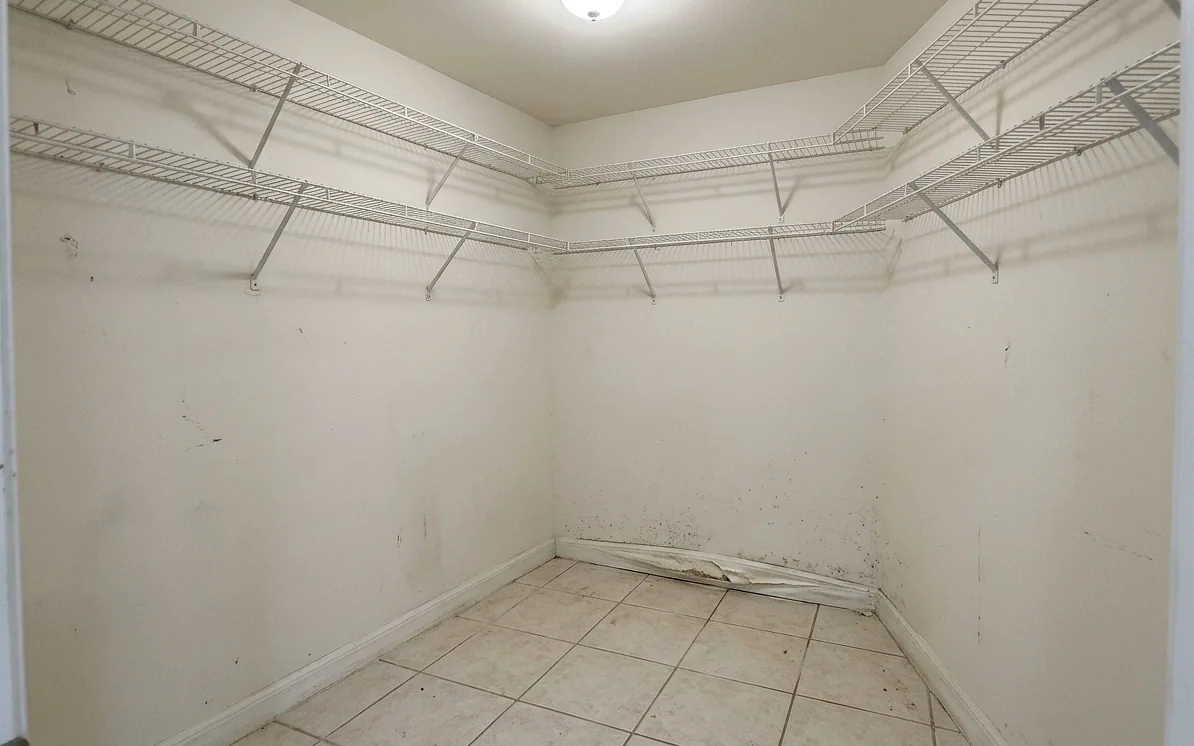
Many closets share a wall with a bathroom, a laundry room or an AC closet. A slow leak on the other side of that wall can wet the closet drywall for weeks before anyone notices. By the time the smell shows up, the bottom of the wall may be stained or soft.
Common sources we find on jobs include a shower pan or tub drain that seeps into the wall, a toilet supply line or wax ring leaking at the floor, a washer hose dripping behind the machine, and an AC condensate line or drain pan overflowing next door. In condos, a leak from the unit above can run down inside the wall and show up in your closet first.
Exterior walls bring their own risks. Rain driven against stucco, a failed window seal or a roof leak above can let water into the wall cavity. Older concrete block homes, common in Miami, can also pass moisture through the block if the outside coating has cracked. About 55 percent of Miami's housing units were built before 1980, so aging stucco, window seals and supply lines are part of the picture in many homes.
- Shower pan or tub drain on the other side of the wall
- Toilet supply line or wax ring leaking at the floor
- Washer hose or drain behind a shared laundry wall
- AC drain line or pan overflow in a neighboring closet
- Rain through stucco cracks, windows or the roof above
How to find the cause
Start by emptying the closet. Take everything out, including shoes and boxes on the floor, and look closely at the lower walls, the corners, the back of the shelving and the floor along the baseboard. Gray, green or black spots, a water line, bubbling paint or swollen baseboard all point to moisture.
Then smell the items you took out. If the odor is strongest on the clothes near one wall, or on boxes that sat on the floor, that tells you where the moisture is. Check the room on the other side of each wall for leaks, stains or soft spots.
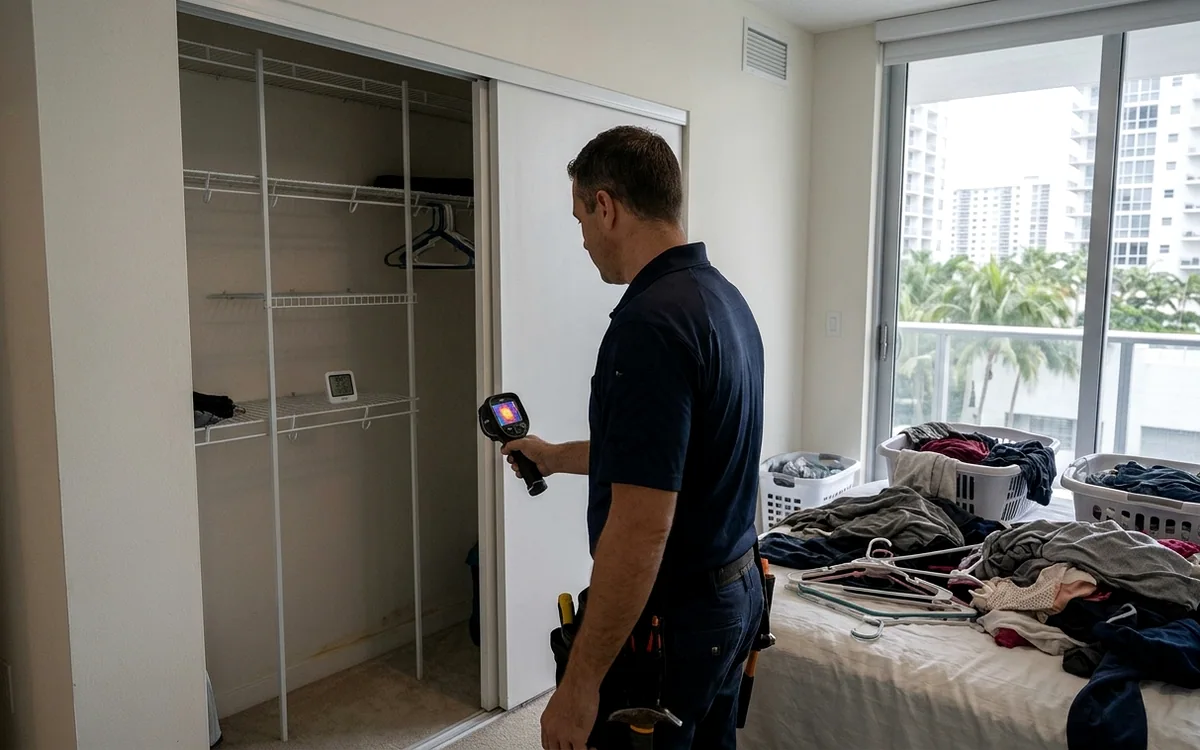
A small hygrometer left in the closet overnight shows the humidity level. If it reads high but you find no stains, the problem is likely air and humidity. If you find stains or a soft wall, a moisture meter or thermal camera can show how far the water goes inside the wall.
Fixes that remove the odor
If the cause is humidity and still air, the fixes are simple. Keep the closet door open part of the day, leave a gap between clothes and the walls, and get boxes and shoes off the floor and onto shelves. A small closet dehumidifier helps, and a louvered door or a return path to the AC can improve airflow.
If the cause is a leak, it has to be fixed first. The EPA says cleaning mold without fixing the water problem usually lets it come back. Once the leak is repaired, the wet drywall and baseboards need to be dried, and any section with mold growth larger than a small spot is usually cut out and replaced.
Clothing and fabric that smell musty can often be washed or dry cleaned. Paper, cardboard and items that have visible growth are usually better thrown away. The EPA says moldy surfaces should not be painted until they are cleaned and dry, so painting over a stained closet wall is not a fix.
- Fix any leak before cleaning or painting
- Dry wet drywall and baseboards with proper equipment
- Cut out drywall with mold growth rather than painting over it
- Wash or dry clean musty fabrics
- Use plastic bins instead of cardboard on closet floors
- Keep a gap between clothing and exterior walls
When the smell keeps coming back
If you have cleaned the closet, aired it out and the odor returns within a few weeks, something is still feeding it. That is usually a slow leak you have not found yet, or mold inside the wall cavity that you cannot see from the closet side.
Homes that stay damp year round, even without a leak, may need help holding humidity down. A whole-home dehumidifier tied into the AC can keep closets and other dead-air spaces in range during Miami summers.
If your closet smells musty and you cannot find why, call us at (786) 947-0034, 24/7. We will check the walls with a moisture meter and thermal camera, find what is feeding the smell, and remove the source rather than masking it.
Reader questions
My closet smells musty but I cannot see any mold. Where is it?
It is often on the back of the drywall, behind the baseboard, under the bottom shelf or on boxes and shoes on the floor. Empty the closet fully and check low on the walls and in the corners. If you still find nothing, a moisture meter can show whether a wall is wet inside.
Will a closet dehumidifier fix the smell on its own?
It can, if the only cause is humid, still air. It will not fix a leak behind the wall, and running one against an active leak just hides the problem longer. Check the walls first, then use a dehumidifier to keep humidity down.
Do I need to throw out clothes that smell musty?
Usually not. Most clothing and fabric can be washed or dry cleaned to remove the odor. Leather, paper, cardboard and items with visible growth are harder to save. Do not put cleaned items back until the closet itself is dry and the source is fixed.
More guides from our crews
AC drain line leaks in Miami condos
In a Miami condo, the air conditioner runs most of the year and pulls gallons of water out of the air. When the small drain line that carries that wat
Read the guideCan wet drywall be saved after a leak?
Wet drywall does not always have to come out. Whether it can be dried in place depends on what kind of water soaked it, how long it has been wet, and
Read the guideThe first 24 hours after water damage at home
The first day after a leak or flood decides how much of your home can be dried and kept. These are the steps that matter most, in the order we would t
Read the guideWater where it should not be? Call now.
A person answers every call, day or night. Tell us what got wet and when it started, and we will tell you what happens next.