Slab leak water damage drying and repair in Miami
A patch of floor feels warm or damp, tile is cracking or popping loose, and your water bill has jumped, but there is no leak anywhere you can see.
Most Miami homes sit on a concrete slab, and water lines often run under or through it. When one of those lines leaks, the water rises up through the floor and spreads under tile, wood and walls before it shows.
At a glance
- Service
- Slab Leak Water Damage
- Group
- Leaks Inside the Home
- Hours
- Phones answered 24/7
- Office
- 1428 Brickell Avenue, Floor 3, Miami
- Covers
- Miami-Dade and Broward
Call us and we use moisture meters and thermal imaging to show where the floor and walls are wet. A plumber locates and repairs the pipe itself, and we work alongside them. Once the line is fixed, we remove flooring that cannot be saved and dry the slab and walls. Wet materials should start drying within 24 to 48 hours.
Who does what on a slab leak
A slab leak has two parts: the broken pipe and the water damage it leaves behind. The pipe repair is done by a plumber, who may reroute the line or open the slab to reach it.
Our part is the water. We find the wet areas, help show the plumber where the moisture is heaviest, then dry and repair the floor and walls once the line is fixed.
How water moves under a slab
Concrete is porous. Water from a pressurized line pushes up through the slab and spreads under flooring, often far from the actual leak point.
Florida homes are built on slabs instead of basements because of the high water table and porous limestone ground, so there is nowhere for that water to drain away. It wicks into the bottom of walls and stays there.
Finding the wet area
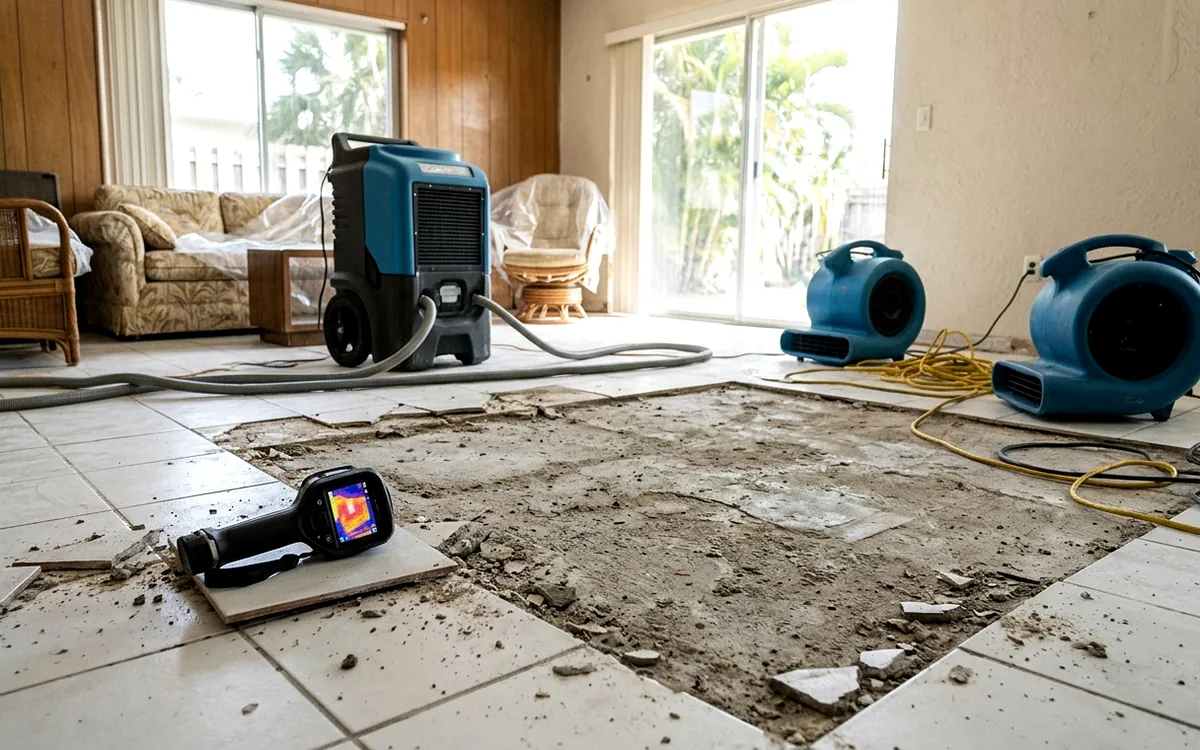
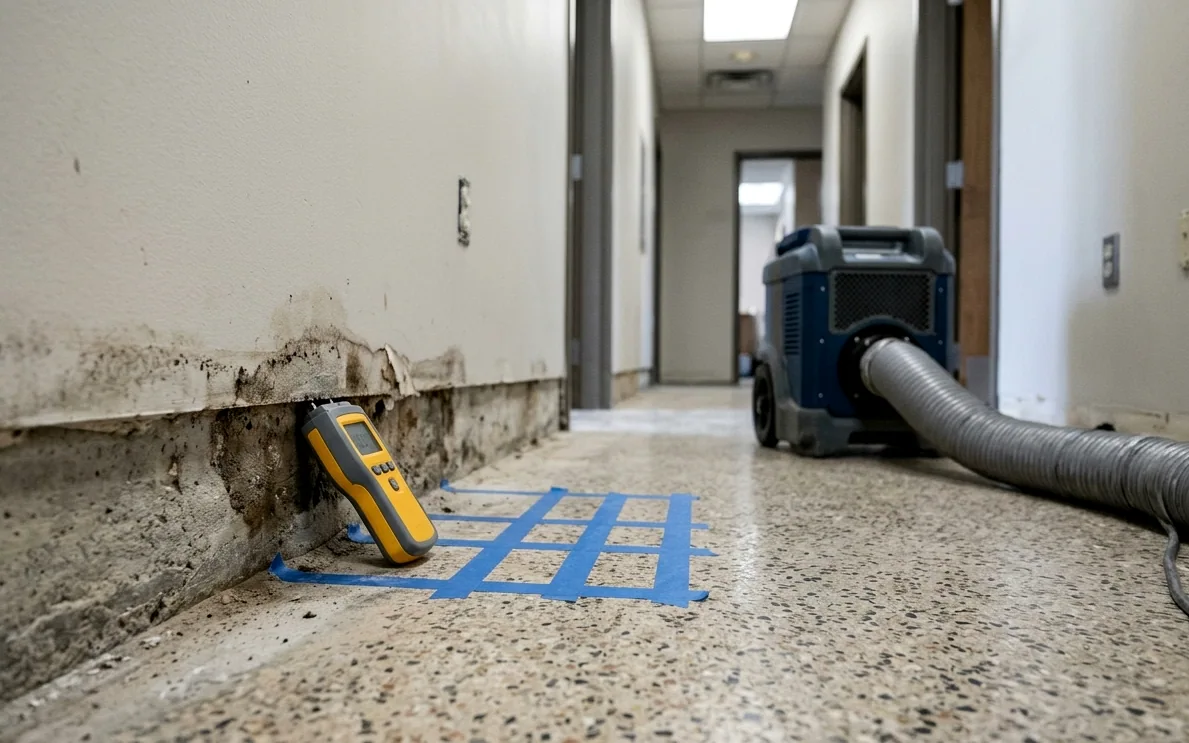
A thermal camera picks up warm spots from hot water lines and cool spots where water is evaporating. Pin and pinless meters confirm which tile, wood or drywall is actually wet.
- Thermal scan of floors and wall bases
- Moisture readings on a grid across each room
- Checks inside cabinets and closets on the slab
- Notes and photos marking the wettest zones
- A moisture map you can share with your plumber and insurer
Drying concrete takes patience
Concrete holds water and releases it slowly, which puts it in the specialty drying class. We often remove the flooring over the wet zone so the slab can breathe, then run dehumidifiers and air movers with the room closed up.
Daily readings tell us when the slab is ready. New tile, wood or vinyl put down over a wet slab will fail, so we wait for the numbers.
Putting the floor back
Once the slab is dry, we replace baseboard, patch drywall and prepare the floor for new covering. If the plumber cut into the slab, the concrete is patched before any flooring goes down.
Matching old tile can be hard, so we talk through options early, such as using leftover boxes or creating a clean break at a doorway.
Miami-Dade sits close to sea level with groundwater just below the surface, and the Biscayne Aquifer is porous limestone only a few feet down in most places. That is why homes here are built on slabs, and why water from a slab leak has nowhere to go but up into your floors and walls.
When to call about slab leak water damage
Warm spot on the floor
A patch of tile that feels warm under bare feet can point to a hot water line leaking below.
Cracked or hollow tile
Tiles that crack, sound hollow or come loose in one area may have water pushing up under them.
Water bill climbing
A higher bill with no change in use is a common first clue of a hidden pressurized leak.
Sound of running water
Hearing water when every fixture is off suggests a line is leaking somewhere in the house.
Damp carpet with no source
Carpet that stays wet in one spot without a spill above it often sits over a slab leak.
Wet wall bases on interior walls
Moisture at the bottom of an interior wall, away from windows and plumbing fixtures, can come up from the slab.
What happens after you call
Moisture mapping visit
We scan and meter the floors and walls to show where the water is and how far it has spread.
Plumber repairs the pipe
Your plumber locates the exact break and repairs or reroutes the line.
Remove damaged flooring
Tile, wood or vinyl over the wet zone is lifted so the slab can dry.
Dry the slab and walls
Dehumidifiers and air movers run in a closed room while we log readings each day.
Confirm it is dry
Final readings are compared to dry areas of the same house before anything is closed up.
Restore floors and walls
Concrete patches, drywall, baseboard and new flooring are put back.
What slab leak water damage usually costs in Miami
Slab leaks are often mid-sized to large jobs because the water spreads under several rooms. These are typical Miami-area ranges for the drying and restoration side only, not the plumbing repair.
| What is priced | Typical range |
|---|---|
| Water extraction and drying, per sq ft | $3.95 to $5.80 per sq ft |
| LGR dehumidifier, per day | $89 to $123 |
| Desiccant dehumidifier for slab drying, per day | $155 to $245 |
| Typical slab leak restoration job | $1,640 to $6,190 |
The price moves with the size of the wet area, the flooring type and how long the slab takes to dry. The final price is set after an on-site look. See every cost range we publish.
Slab Leak Water Damage: common questions
Do you fix the leaking pipe under the slab?
No, the pipe repair is done by a plumber. We handle the water damage: finding the wet areas, drying the slab and walls, and repairing the floor and drywall afterward.
Can my tile stay down while the slab dries?
Sometimes, if the wet area is small and the tile is still firmly stuck to the slab. Over a larger wet zone, tile and thinset trap the moisture and slow drying, so lifting it is often faster in the end.
How long does a wet slab take to dry?
It depends on how long the leak ran and how thick the concrete is. Many slab jobs take longer than drying drywall, which is why we track readings daily instead of setting a fixed number of days.
Should I wait for the plumber before calling you?
No. Call both at the same time. Our moisture map helps show where the floor is wettest, and drying can begin as soon as the line is shut off or repaired.
Will the plumber's reroute leave holes in my walls?
A reroute often runs new line through walls or the attic, which means a few access openings. We can patch those along with the water damage so the repairs finish together.
Often needed on the same job
Leak Detection & Moisture Mapping
Thermal imaging and meters to trace hidden water inside walls and floors.
See the serviceStructural Drying & Dehumidification
Air movers and dehumidifiers set up, logged daily and pulled once dry.
See the serviceHardwood Floor Drying
Cupping wood floors dried in place with floor mats when they can be saved.
See the serviceWater Damage Repair
Drywall, baseboards, paint and trim put back once the structure is dry.
See the serviceWater where it should not be? Call now.
A person answers every call, day or night. Tell us what got wet and when it started, and we will tell you what happens next.