Commercial mold remediation in Miami offices and shops
Someone found mold behind a display wall, above a ceiling grid or in a back office, and now you need it removed without shutting the business down or spreading it to the next suite.
Mold in a commercial space affects staff, customers and sometimes neighboring tenants. We contain the area, remove the growth, fix or flag the moisture behind it, and plan the noisy, dusty parts of the work around your operating hours.
At a glance
- Service
- Commercial Mold Remediation
- Group
- Condos & Commercial
- Hours
- Phones answered 24/7
- Office
- 1428 Brickell Avenue, Floor 3, Miami
- Covers
- Miami-Dade and Broward
When you call, we ask where the mold is, roughly how large it looks and when the space is in use. A project manager visits, measures the affected area, finds the moisture source and sets the containment plan. Mold keeps spreading while materials stay damp, so it is worth calling soon, even if the work itself is scheduled after hours.
How containment is sized
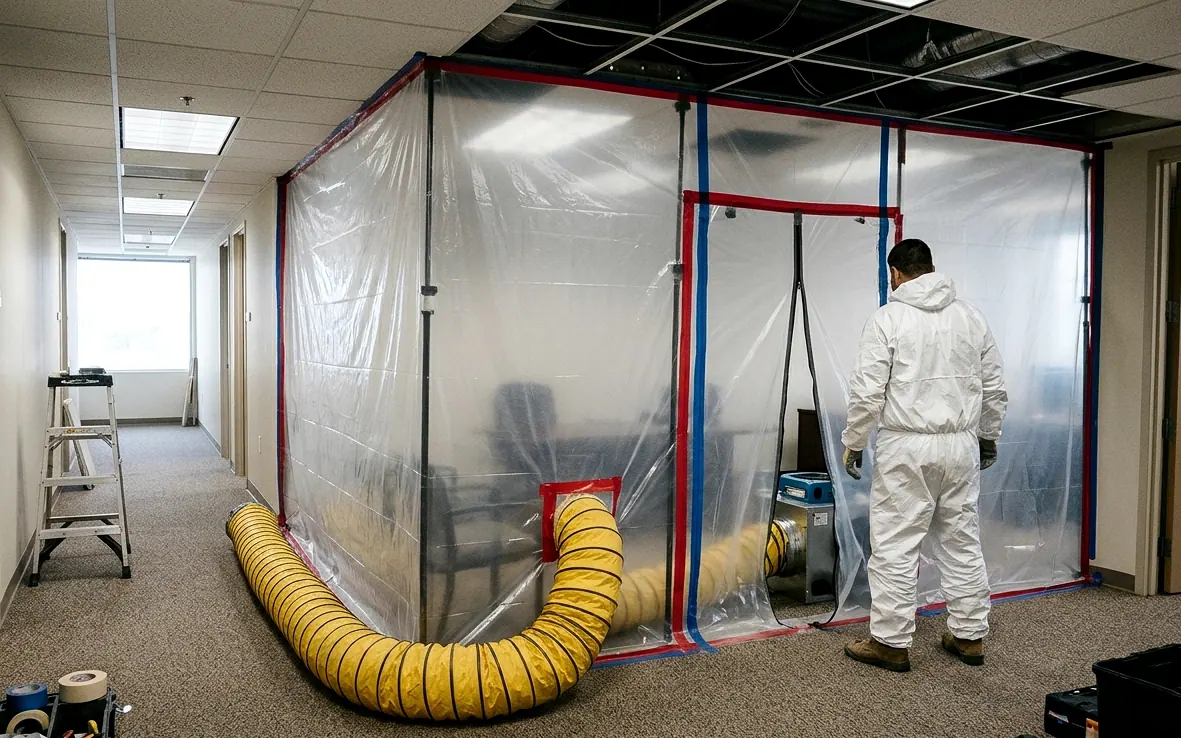
EPA guidance for commercial buildings recommends limited containment with a single layer of polyethylene sheeting for 10 to 100 square feet of mold. Above 100 square feet, it recommends full containment with double sheeting and an airlock. We measure first so the containment fits the job instead of guessing.
Inside containment, air filtration keeps dust moving toward the filters and away from occupied rooms. That is what keeps the suite next door, the hallway and your staff out of the work.
- Under 10 sq ft: careful cleanup with local protection
- 10 to 100 sq ft: limited containment, single sheeting
- Over 100 sq ft: full containment, double sheeting, airlock
Working around your operating hours
Demolition and bagging are the dustiest parts of the job, so we can schedule them before opening, after close or over a weekend. Once containment is up and air filtration is running, quieter work can often continue while the rest of the space stays open. We agree on the schedule before the first panel of sheeting goes up.
Restaurants, clinics and retail floors each have their own limits. We ask about deliveries, patient hours, inventory and anything else that affects when and where the crew can work.
Removing what cannot be cleaned
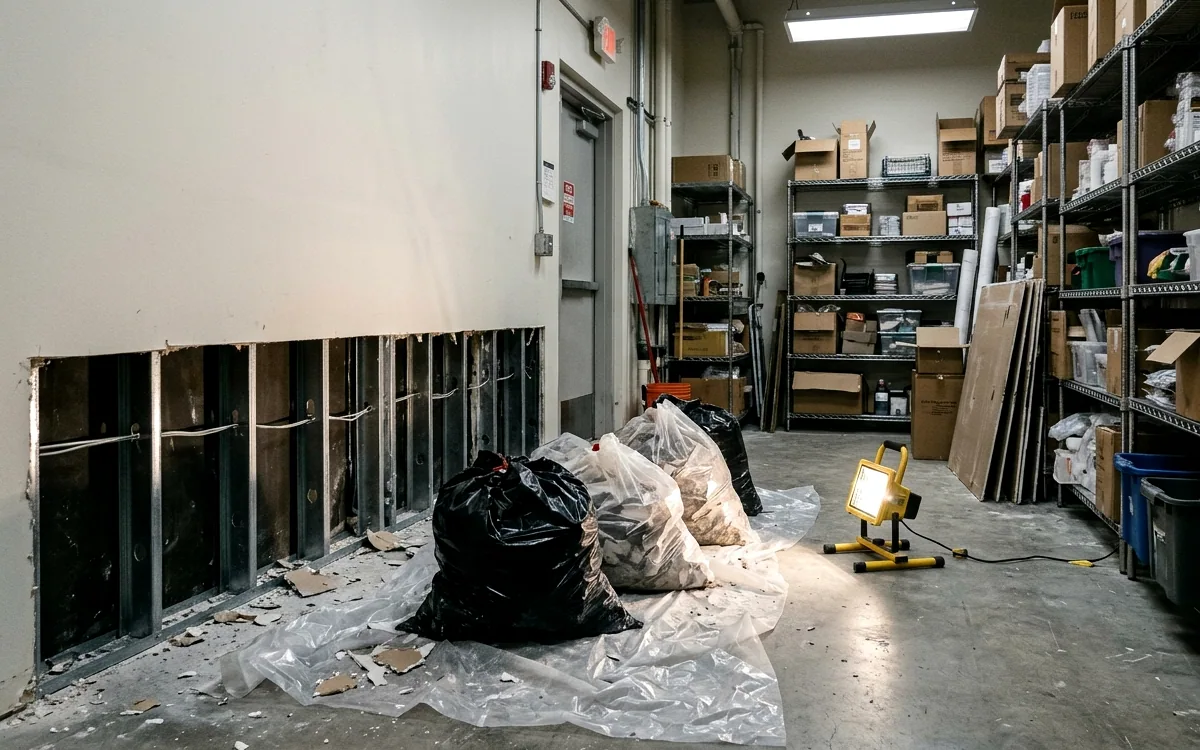
Porous materials with mold growing into them, like drywall, ceiling tiles, insulation and carpet, are cut out and bagged inside containment. Hard surfaces such as metal studs, concrete and sealed wood are cleaned. The EPA says moldy surfaces should not be painted or caulked until they are cleaned and dry.
We photograph the area before, during and after removal. That record helps the property manager, the tenant and any insurer see what was taken out and why.
Fixing the moisture behind it
The EPA says cleaning mold without fixing the water problem usually lets it come back. In commercial buildings the usual causes are roof leaks, condensation on cold ducts, AC drain problems and slow plumbing leaks inside walls. We trace the moisture with meters and thermal imaging and tell you what needs repair.
Where the repair belongs to a plumber, roofer or HVAC contractor, we explain what we found so they can fix it before walls are closed. Drying equipment can run while that happens.
Clearance and Florida's separation rule
Florida keeps mold assessment and mold remediation separate on the same structure. A remediator cannot assess a building it remediated within the previous 12 months. So we never grade our own work: an independent assessor and lab check the space after we finish.
We coordinate timing with the assessor so containment stays up until results come back. If an area does not pass, we clean it again and the assessor checks it again.
Average relative humidity in Miami is about 82 percent in the morning, and August mornings average about 83 percent. The EPA recommends keeping indoor humidity below 60 percent, so a closed-up suite or an AC on a weak schedule can grow mold quickly here.
When to call about commercial mold remediation
Spots on ceiling tiles
Dark speckles or rings on dropped ceiling tiles often mean a slow leak or condensation above the grid.
Musty suite odor
A damp smell in a closed office, stockroom or restroom is often the first clue before anyone sees growth.
Staff symptoms indoors
Stuffy noses, coughing or itchy eyes that ease away from the building are worth taking seriously, since the CDC lists these as possible reactions to mold.
Growth behind fixtures
Mold found when a display, cabinet or shelving unit is moved usually means moisture was trapped against that wall.
Wet for over 48 hours
Any area that stayed wet more than two days after a leak or storm is likely to grow mold, even if nothing shows yet.
Sweating ducts and vents
Condensation dripping from supply vents or duct wrap can feed growth on nearby ceilings and insulation.
What happens after you call
Call and describe it
Tell us where the mold is, how large it looks and when the space is occupied.
Site visit and measure
We measure the affected area, trace moisture and agree on the containment size and schedule.
Build containment
Sheeting, an airlock where needed and air filtration go up before any material is disturbed.
Remove and clean
Moldy porous materials are cut out and bagged, and hard surfaces are cleaned and dried.
Address the moisture
We dry the structure and point the repair trades to the source so it does not return.
Independent clearance
An independent assessor and lab check the space before containment comes down and walls close.
What commercial mold remediation usually costs in Miami
Mold work is usually priced by affected area and the containment it needs. These are typical Miami-area ranges, and the real number depends on what is behind the surface.
| What is priced | Typical range |
|---|---|
| Small area, 10 to 100 sq ft, limited containment | $540 to $1,460 |
| Removal under containment, per sq ft | $15.40 to $28.70 |
| Typical single-suite job | $1,640 to $8,720 |
| Drying with an LGR dehumidifier, per day | $88 to $121 |
Price moves with the size of the area, the containment level, after-hours scheduling and how much material has to come out. The final price is set after an on-site look, and the independent assessor bills separately. See every cost range we publish.
Commercial Mold Remediation: common questions
Can mold work happen while our office stays open?
Usually part of it can. Dusty demolition is scheduled outside your hours, and once containment and air filtration are running, quieter work can continue behind the sheeting.
Will the tenant next door be affected by the work?
Containment and air filtration are set up to keep dust inside the work area. If the mold sits on a shared wall, we talk with building management about access on both sides before starting.
Why can you not test the space yourselves after removal?
Florida law bars a remediator from assessing a structure it remediated within the previous 12 months. An independent assessor and lab do the clearance check, which also gives you a result no one can say the contractor graded.
Is painting over mold on a commercial wall enough?
No. The EPA says moldy surfaces should not be painted or caulked until they are cleaned and dry, and growth inside drywall usually has to be cut out. Paint only hides it for a while.
How large does a commercial mold area have to be before full containment?
EPA commercial guidance recommends full containment with double sheeting and an airlock once mold covers more than 100 square feet. Between 10 and 100 square feet, limited containment with single sheeting is typical.
Often needed on the same job
Commercial Water Damage
Offices, retail, restaurants and warehouses dried with minimal downtime.
See the servicePost-Remediation Clearance Testing
Independent verification that a mold job passed before walls close.
See the serviceMold Inspection
A walk-through with meters and thermal imaging to find mold and its cause.
See the serviceAC Air Handler Mold Cleaning
Mold in air handler closets, on coils and around supply vents.
See the serviceWater where it should not be? Call now.
A person answers every call, day or night. Tell us what got wet and when it started, and we will tell you what happens next.