Mold removal and water cleanup across Miami‑Dade County, 33128
Across Miami-Dade, water arrives in more ways than most counties ever see: hurricanes and surge on Biscayne Bay, king tides, summer cloudbursts that swamp the canals, and septic systems that fail when the water table rises.
Miami-Dade County runs from the barrier islands west into the Everglades, with 34 incorporated municipalities and more than a million people in unincorporated areas. Kelda Restoration works across it from our office in Miami, the county seat, removing water and the mold that follows it.
At a glance
- Area
- Miami-Dade County
- From our office
- 1428 Brickell Ave, Floor 3
- Phones
- Answered 24/7
- Most calls
- Storm & Hurricane Water Damage
We cover Miami-Dade County, including Miami, Miami Beach, Coral Gables, Hialeah, Doral, Kendall, Miami Gardens, North Miami, Aventura and more. Most county-wide work is storm and flood cleanup, condo leaks, septic and sewage backups and mold removal. Call (786) 947-0034, answered 24/7, and tell us your city or neighborhood.
From condo towers to ranch homes to new subdivisions
The 2020 Census counted 2,701,767 county residents, and the county estimates about 2,802,029 for 2025. Housing ranges from the condo towers of Miami and Miami Beach to post-war CBS ranch homes and newer subdivisions further west and south.
That range changes the job. Miami-Dade has about 313,352 condo units in roughly 5,356 associations, where a leak quickly becomes a question of which unit and which policy. In a single-story concrete block home on a slab, the work is more about pulling water off the floor and drying the lower walls before mold starts.
Storms, tides, rain and groundwater
Hurricane Andrew struck on August 24, 1992 and caused more than $25 billion in damage in the county. The pattern since then is familiar: surge on Biscayne Bay, roofs opened by wind, and rain driven sideways through windows. Hurricane season runs June 1 to November 30, with the peak around September 10.
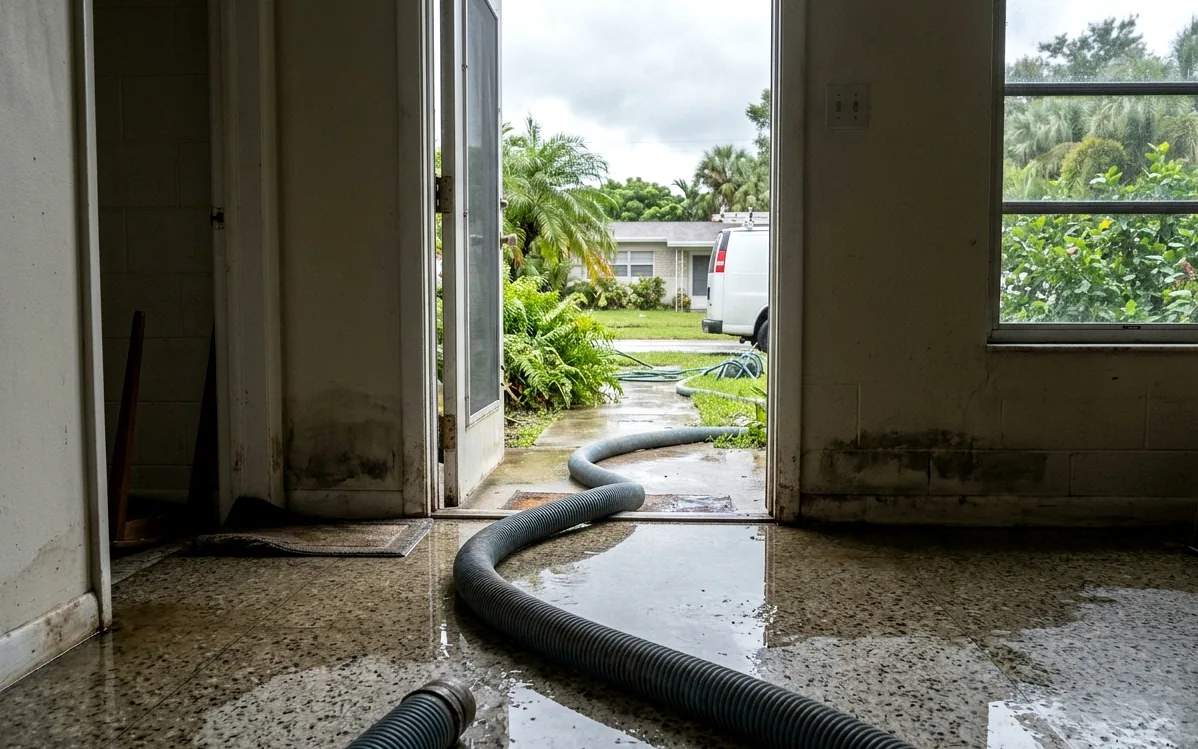
Rain alone can do it. On June 12, 2024, the governor declared a state of emergency for Miami-Dade and Broward after 4 to 6 inches fell in Miami-Dade and nearly 7 inches at Miami Beach in 24 hours. Groundwater sits just below the surface here, and about 120,000 properties rely on septic tanks that can stop working and back wastewater into homes when the water table rises.
How we run jobs county-wide
Condo towers come with building rules: elevator bookings, loading dock times and management sign-off. Florida's post-Surfside law also requires milestone inspections for condo buildings three or more stories tall, so associations watch water intrusion closely. We work alongside management and keep photos and moisture logs that fit how Florida splits repairs between the association and the owner.
In houses, the first question is the water category. Rain and clean supply-line water can often be dried in place, while flood water and septic or sewage backups mean soaked porous materials come out. Mold jobs follow Florida's separation rule: we inspect and remediate, and an independent assessor handles any lab testing and clearance.
Cities and neighborhoods we cover in the county
Inside the City of Miami we work in Brickell, Downtown, Edgewater, Coconut Grove, Little Havana, Allapattah, Little Haiti, the Upper Eastside and more. Beyond the city line we cover Miami Beach, Coral Gables, Hialeah, Doral, Kendall, Miami Gardens, North Miami, North Miami Beach, Aventura, Sunny Isles Beach, Key Biscayne, Pinecrest, Palmetto Bay, Cutler Bay, Homestead, South Miami, Miami Lakes, Miami Springs and Westchester.
Every job is dispatched from 1428 Brickell Avenue in Miami. Our own crews and equipment handle the work, and on the rare night every crew is committed, the call goes to another trusted local restoration provider so you are not left waiting.
Where water and mold start in Miami-Dade County
Hurricane Andrew's mark
Andrew struck on August 24, 1992 and caused more than $25 billion in damage in the county.
June 2024 rain emergency
After 4 to 6 inches of rain across Miami-Dade and nearly 7 inches at Miami Beach in 24 hours, a state of emergency followed.
120,000 septic properties
When rain and rising seas lift the water table, these systems can fail and push wastewater back into homes.
Milestone condo inspections
Florida's post-Surfside law requires milestone inspections for condo buildings three or more stories tall, coastal towers included.
Services we run most in Miami-Dade County
Storm & Hurricane Water Damage
Wind-driven rain, surge and roof breaches after tropical weather.
See the serviceFlood Damage Cleanup
Rising water and street flooding cleaned out, with flood cuts where needed.
See the serviceSewage Backup Cleanup
Category 3 water removed, porous materials cut out, surfaces disinfected.
See the serviceCondo Water Damage
Unit-to-unit leaks in high-rises, worked alongside building management.
See the serviceMold Removal
Containment, removal and cleaning of mold, with the moisture source fixed.
See the serviceInsurance Claim Documentation
Photos, moisture logs and scope notes organized for your adjuster.
See the serviceMiami-Dade County: questions we hear
Which parts of Miami-Dade County do you cover?
We cover the City of Miami and cities across Miami-Dade County, including Miami Beach, Coral Gables, Hialeah, Doral, Kendall, Miami Gardens, North Miami, Aventura and Homestead. Tell us your address when you call and we will confirm the crew and timing.
My septic system backed up after heavy rain in Miami-Dade County. Is that damage you handle?
Yes. About 120,000 Miami-Dade properties use septic tanks, and high groundwater can make them back up into the house. That water is contaminated, so we extract it, remove soaked porous materials and disinfect what remains. Call your septic contractor for the system itself.
Does homeowners insurance in Miami-Dade County cover flood water?
FEMA says most standard homeowners policies do not cover flood damage, which needs a separate flood policy. A burst pipe or roof leak during a storm may be treated differently than rising water. We document everything with photos and moisture logs so your adjuster can sort out which coverage applies.
How quickly does mold start after water damage in Miami-Dade County?
The EPA advises drying wet areas within 24 to 48 hours to prevent mold, and Miami-Dade's humidity makes that window feel short, with dew points in the 70s almost daily in the wet season. The sooner drying starts, the less material has to be removed.
Other places our crews cover
Water damage in Miami-Dade County? Call our crew lead.
A person answers every call, day or night. Tell us what got wet and when it started, and we will tell you what happens next.