Leak detection and moisture mapping in Miami, FL
You can see a stain, smell something damp or hear water running, but you cannot tell where the water is going or how far it has spread inside the walls.
Water travels along studs, under tile and across slab, so the wet area is often bigger than the stain and sometimes nowhere near it. We use thermal imaging and moisture meters to trace the path and draw a map of every wet material. That map shows what has to dry, what has to come out and where the source most likely sits.
At a glance
- Service
- Leak Detection & Moisture Mapping
- Group
- Drying & Repairs
- Hours
- Phones answered 24/7
- Office
- 1428 Brickell Avenue, Floor 3, Miami
- Covers
- Miami-Dade and Broward
When you call, we ask what you are seeing and send a technician with a thermal camera and meters. We scan the area, confirm wet spots with direct readings and sketch a moisture map room by room. If a leak is still active, shutting the right valve comes first, since the EPA advises drying within 24 to 48 hours.
What thermal imaging shows, and what it does not
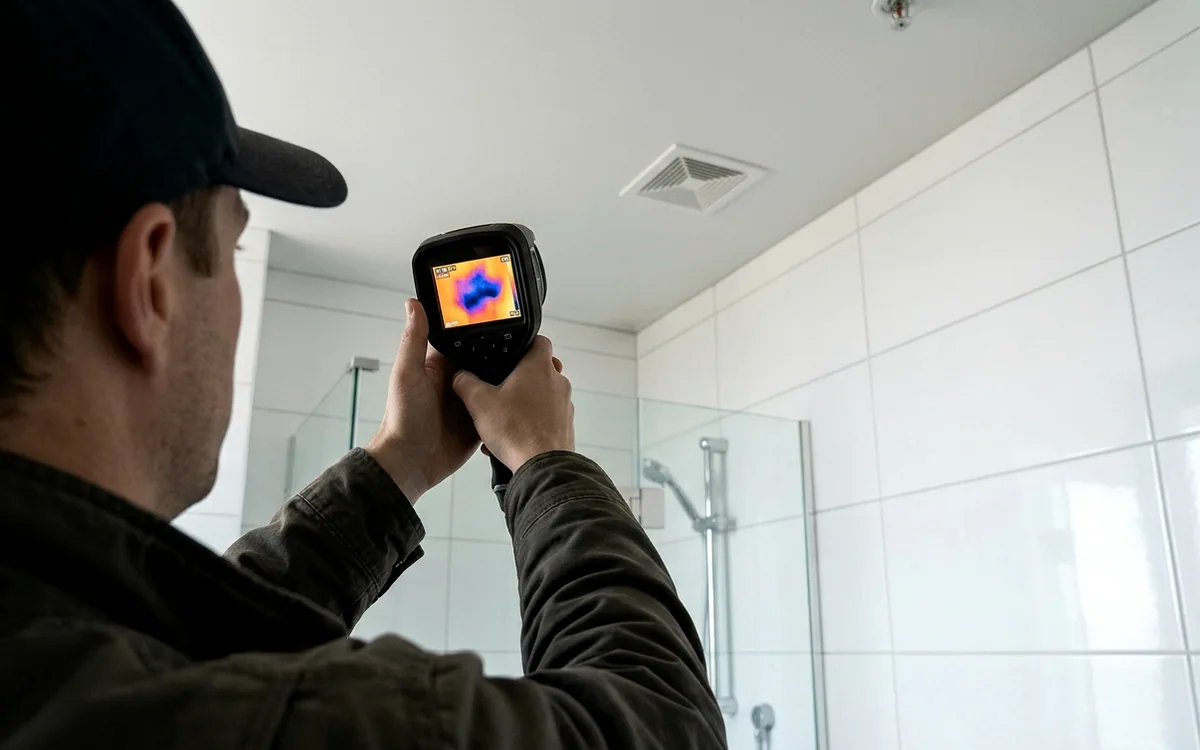
A thermal camera shows temperature, not water. Wet drywall usually reads cooler because evaporation pulls heat out of it, so a damp patch shows up as a darker shape on the screen.
Cold air from a supply vent, a shaded exterior wall or a freshly mopped floor can look the same. That is why we never call a wall wet from the camera alone. Every suspect spot gets a direct meter reading before it goes on the map.
The meters we use to confirm
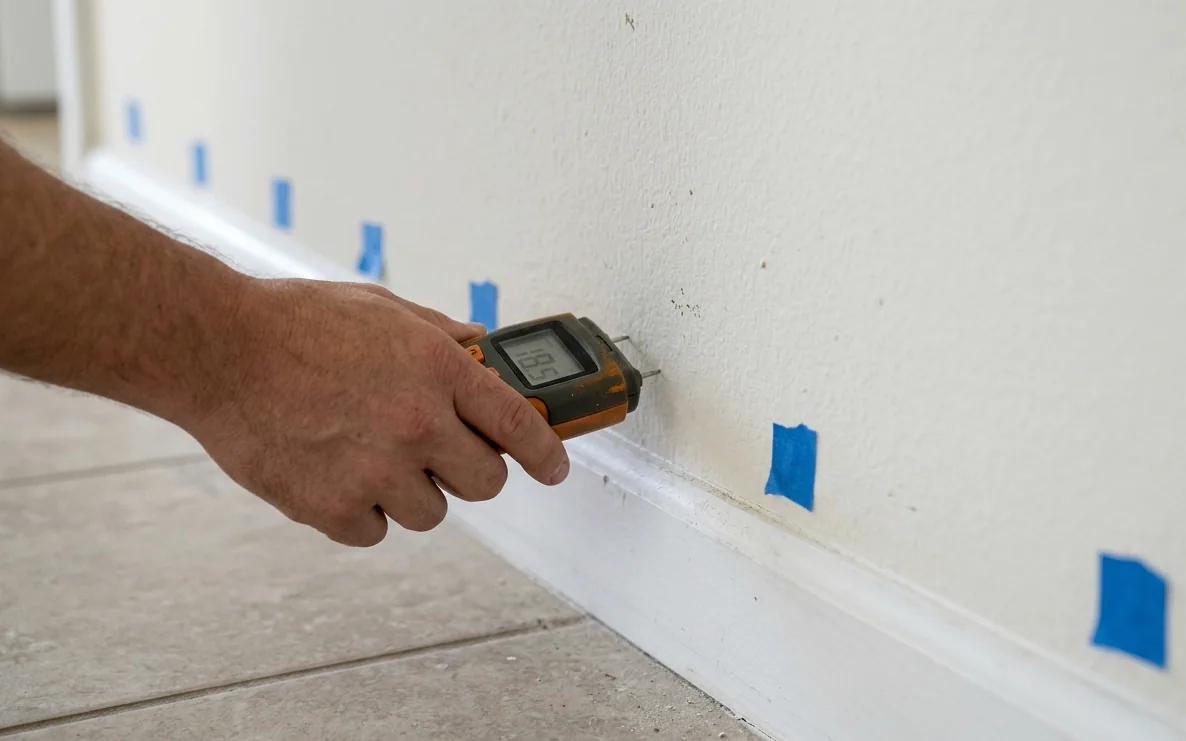
A non-invasive meter reads through the surface without leaving marks, which works well on drywall, tile and cabinets. A pin meter goes into the material for a number we can log and compare day to day.
We also take readings in a dry part of the home to set a reference. A wall counts as wet when it reads above that reference, not when it passes some number printed on the meter.
- Thermal camera for a fast first scan
- Non-invasive meter for tile, cabinets and finished walls
- Pin meter for logged readings in drywall and wood
- Thermo-hygrometer for room air and dew point
Tracing the water back toward its source
Water moves downhill and sideways along framing, so we follow the wet readings to their highest and farthest point. A pattern that starts at a window corner points one way, a ring around a toilet flange points another, and a wet line beside the air handler closet points to the condensate drain.
The IICRC S500 assumes the property owner is responsible for finding and correcting the water source, though owners may hire experts to do it. We tell you where the water most likely starts and which trade, such as a plumber or roofer, should open it up and fix it.
Reading the moisture map
The map is a floor plan with each wet area outlined and readings written in. It shows which walls are wet and to what height, which flooring is wet underneath, and where readings drop back to dry.
That sheet becomes the drying plan. It also goes into your claim file, so an adjuster can see why a wall was cut at 2 feet and not 4, or why one room needed equipment and the next did not.
Mapping again while the home dries
A map is not a one-time picture. We re-read the same marked points each day of drying and record the numbers, so you can watch the wet area shrink.
Final readings close the job. When every point on the map matches the dry reference, the equipment comes out and repairs can start.
The NWS defines the South Florida wet season as May 15 to October 15, and dew points in the 70s are an almost daily occurrence in those months. Air that humid can leave cool interior surfaces damp from condensation, so in Miami we confirm every cool spot on the camera with a meter before calling it a leak.
When to call about leak detection & moisture mapping
Stain with no clear source
A ceiling or wall stain appears and nothing directly above or beside it looks wet.
Tile sounds hollow
Floor tile that rings hollow or shifts underfoot can sit on a wet setting bed or over a slab leak.
Water bill jumped
Usage is up with no change in habits, which can mean water is running somewhere you cannot see.
Damp smell, dry surfaces
A musty odor fills a room where every surface looks and feels dry.
Unit below reports water
Your downstairs neighbor or building manager says water is coming from your unit.
Repairs keep failing
Paint keeps bubbling or a patch keeps staining, so water is still reaching the wall.
What happens after you call
Describe what you see
On the call we ask where the stain or smell is and when you first noticed it.
Thermal scan
The technician sweeps walls, ceilings and floors with the camera to spot cool, damp patterns.
Confirm with meters
Each suspect area gets direct readings, compared with a dry reference in your home.
Draw the map
Wet areas, heights and readings go onto a room-by-room floor plan.
Point to the source
We explain where the water most likely starts and which trade should repair it.
Plan the drying
The map becomes the scope for drying, any removal and your claim photos.
What leak detection & moisture mapping usually costs in Miami
These are typical Miami-area ranges for the visit and the drying that often follows a mapping job. A mapping visit on its own is usually short.
| What is priced | Typical range |
|---|---|
| After-hours emergency call fee | $55 to $195 |
| Technician time for scanning and mapping, per hour | $76 to $189 |
| Small Class 1 dry-out when mapping finds limited water | $158 to $392 |
| LGR dehumidifier if drying follows, per day | $87 to $124 |
The number of rooms we scan, ceiling height and access, such as a locked unit above yours, change the time on site. You get a final price after an on-site look. See every cost range we publish.
Leak Detection & Moisture Mapping: common questions
Can a thermal camera see through walls?
No. It reads the surface temperature of the wall, and wet materials usually show as cooler. It points us to suspect areas fast, and a meter then confirms whether that area is actually wet.
Will you find the exact pipe that is leaking?
We trace the water to its most likely starting point and show you why, using the pattern of readings. Opening the wall and repairing the pipe, roof or window is work for a plumber or the right trade, and we can plan our drying around their visit.
Do you need to make holes to map moisture?
Most readings come from non-invasive meters and the camera, which leave no marks. Pin readings leave tiny holes that disappear under paint, and larger access holes are drilled only if a cavity needs to be dried.
Is a moisture map useful for my insurance claim?
Yes. It shows the adjuster which materials were wet, how high, and why each removal or piece of equipment was needed. We date the map and every daily reading that follows.
My downstairs neighbor says water is coming from my unit. What do I do first?
Shut off the supply to the fixture you suspect, or the unit main if you are not sure, and tell building management. Then call us so we can map both units and show where the water is moving.
Often needed on the same job
Structural Drying & Dehumidification
Air movers and dehumidifiers set up, logged daily and pulled once dry.
See the serviceSlab Leak Water Damage
Leaks under the slab that lift tile and wet flooring from below.
See the serviceCeiling Water Damage
Stains, sagging drywall and leaks from the unit or attic above.
See the serviceMold Inspection
A walk-through with meters and thermal imaging to find mold and its cause.
See the serviceWater where it should not be? Call now.
A person answers every call, day or night. Tell us what got wet and when it started, and we will tell you what happens next.