Why AC drain lines clog and soak Miami condo units
In a Miami condo, the air conditioner runs most of the year and pulls gallons of water out of the air. When the small drain line that carries that water away clogs, the water has to go somewhere, and it usually goes into your floor.
Written from what our crews see on Miami jobs, for homeowners, condo owners and property managers.
At a glance
- Written by
- Winston Albright
- Role
- Guides Editor and Restoration Project Lead
- Updated
- November 2026
- Reading time
- 6 minutes
- Miami air conditioners pull a lot of water from the air, and a clogged drain line sends it into your floors.
- Slime, dust and poor slope are the usual causes, and the line rarely gets a chance to dry here.
- Clammy air, swollen baseboards and a tripped float switch are early warning signs.
- Clearing the line stops the leak, but the wet closet and nearby rooms still need to be dried.
Where all that water comes from
Your AC does two jobs at once: it cools the air and it dries it. As warm, damp air passes over the cold evaporator coil inside the air handler, moisture condenses on the coil the same way water beads on a cold glass. That water drips into a pan under the coil and flows out through a small PVC drain line.
In Miami the amount of water is large. Average morning relative humidity runs about 82 percent across the year, and the National Weather Service notes that dew points in the 70s are an almost daily occurrence during the wet season. On a humid summer day, an air handler serving a two-bedroom unit can produce several gallons of condensate.
In a high-rise, that line usually ties into a shared condensate riser in the wall or runs to a drain in the utility closet. As long as it flows, you never think about it. When it stops flowing, the pan fills and the overflow begins.
Why condensate lines clog
The water in that line is warm, slow-moving and sitting in the dark, which makes it a good home for algae and bacterial slime. Over months, that slime builds into a gel that narrows the pipe until it closes completely. Dust that gets past a dirty filter adds to the buildup.
Other causes we find on condo jobs are just as ordinary. A line may have too little slope, so water sits in it. A trap may have dried out or been installed wrong. Sometimes the shared riser is partly blocked further down the building, so the problem is not in your unit at all.
Because the AC almost never gets a rest here, the line almost never gets a chance to dry out and clear. That is one reason clogs are so common in South Florida compared with places where the system sits idle for half the year.
- Algae and bacterial slime growing inside the pipe
- Dust and debris from dirty or missing filters
- Poor slope, so water pools in the line
- A dry, missing or badly built trap
- A partial blockage in the building's shared riser
Signs the drain line is backing up
The U.S. Department of Energy notes that a clogged condensate drain stops the unit from removing humidity, and the extra moisture can discolor walls or carpet. So the first sign is often not a puddle at all. The unit simply feels clammy even though the thermostat says it is cool.
Other early signs are easy to spot once you know them. Water collects in or around the pan under the air handler. Baseboards next to the AC closet darken or swell. The carpet or the floor right outside the closet door feels damp underfoot, or a musty smell comes from the closet when the system runs.
Many systems have a float switch that shuts the AC off when the pan fills. If your AC suddenly stops cooling on a hot afternoon and there is water in the pan, that switch has probably tripped, and it is telling you the line is blocked.
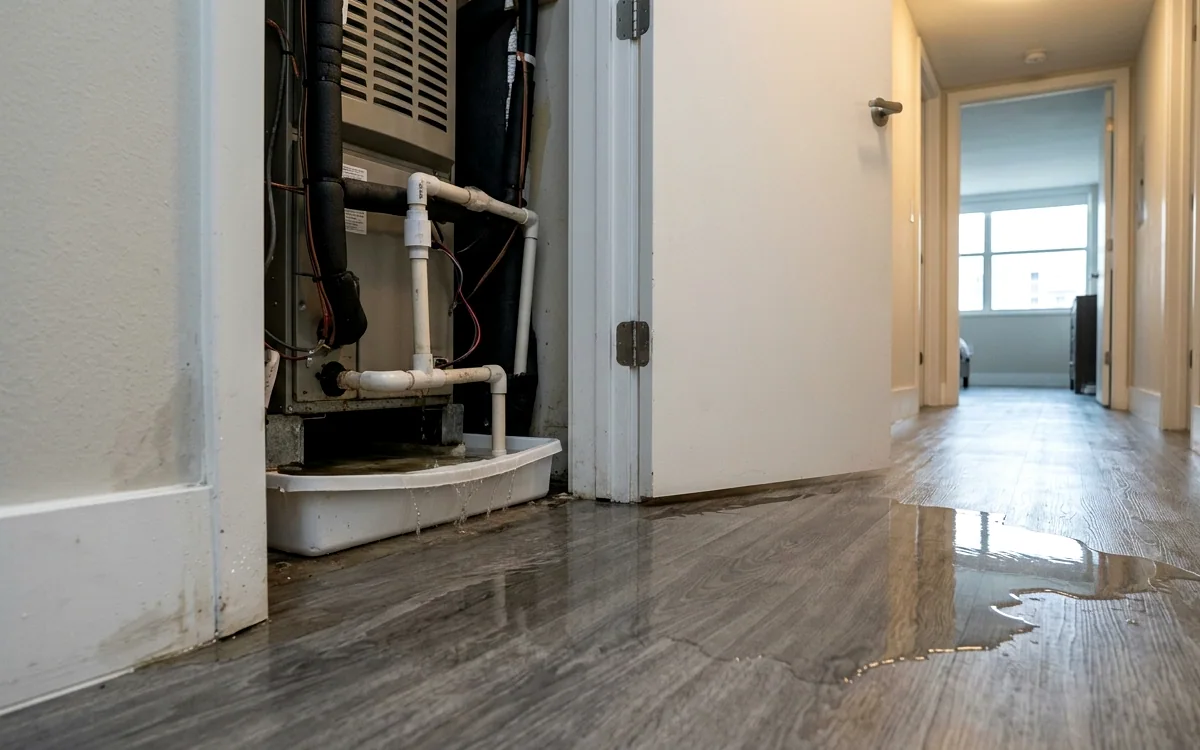
What the overflow does to a unit
Air handler closets in condos are usually small and tucked against an interior wall, a hallway or a bedroom. Water spilling from the pan soaks the closet floor first, then wicks into the drywall, runs under baseboards and spreads beneath laminate, vinyl plank or carpet in the next room.
Because the leak is slow and quiet, it can run for days before anyone notices. By then the bottom of the drywall may be wet several inches up, and the tack strip and pad under carpet may be soaked. In a high-rise, enough water can pass through the slab edge or penetrations to show up as a stain on the ceiling below.
AC condensate is listed as Category 2 water under the IICRC approach, meaning it carries some contamination. That is one reason wet carpet pad from an AC overflow is usually removed rather than dried in place, and why slime in the pan and line should not be handled bare-handed.
What to do when you find water
Turn the AC off at the thermostat, then shut the breaker for the air handler if water is near the unit's wiring. Soak up what is in the pan and on the closet floor with towels. If the closet has an access cap or a cleanout on the line, a wet vacuum on the outlet end can often pull the clog loose.
Then look beyond the closet. Press on the baseboards nearby and check the carpet or flooring just outside the door. If anything is soft, dark or damp, water has gone further than the pan. Tell building management too, especially if the line ties into a shared riser or the unit below reports a stain.
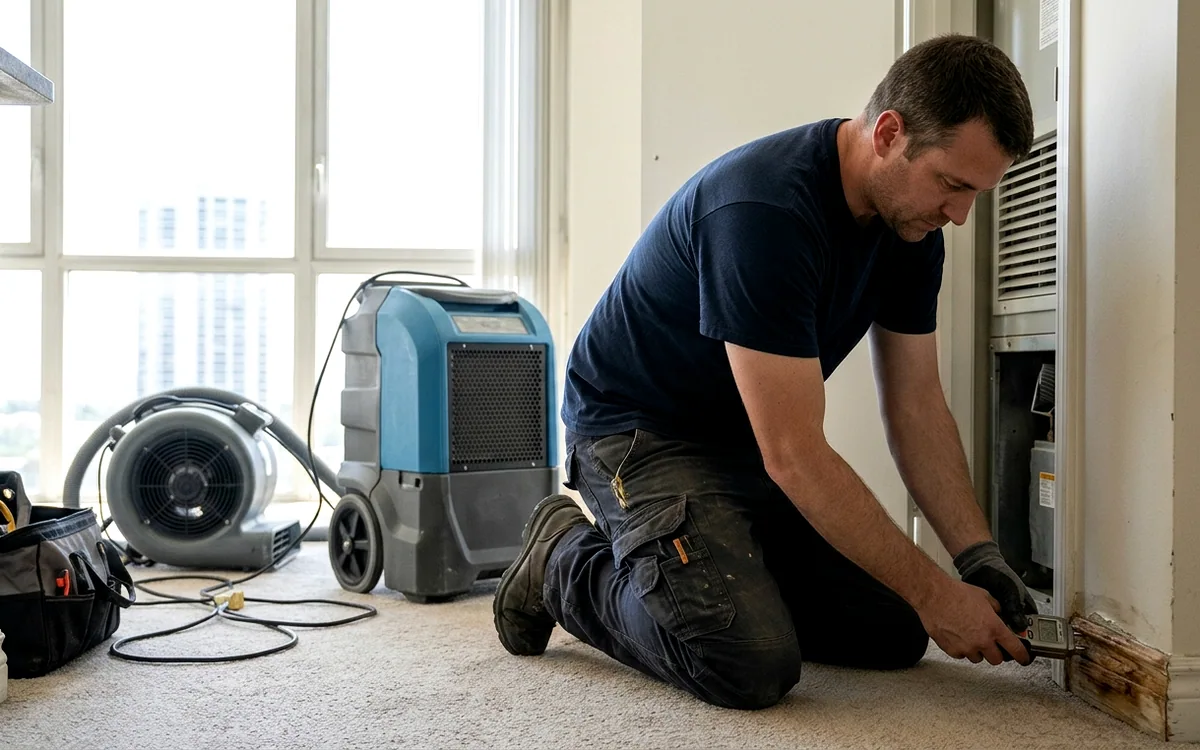
Once the drain is clear, the wet materials still need to dry. That is where moisture readings, air movers and a dehumidifier come in, so the closet and the next room dry fully instead of slowly turning musty.
Upkeep that prevents the next overflow
Prevention is simple and cheap compared with replacing a hallway of flooring. Most of these steps take a few minutes, and the rest are part of normal AC service. Set a reminder so they happen on a schedule rather than after the next leak.
If your unit has had more than one overflow, ask your AC technician whether the line has the right slope and trap, and whether a secondary pan with its own float switch would fit under the air handler. If a leak has already soaked the closet and the floors, call us at (786) 947-0034, 24/7, and we will measure how far the water went and dry it out.
- Replace or wash the AC filter on schedule so dust stays out of the pan.
- Pour a cup of plain white vinegar into the drain line access every one to three months.
- Look at the pan under the air handler when you change the filter.
- Test the float switch during routine AC service.
- Keep stored items off the closet floor so you can see water early.
- Ask your AC technician to check slope and trap after any repeat overflow.
Reader questions
My AC stopped cooling and the pan is full. Is it broken?
Usually not. Many air handlers have a float switch that shuts the system off when the pan fills, to stop an overflow. Clearing the drain line and emptying the pan often brings it back, though it is worth having an AC technician look at why it clogged.
The water only reached the closet floor. Do I need drying equipment?
It depends on what the meter says. If the baseboards, the drywall near the floor and the flooring outside the door all read dry, towels and airflow may be enough. If any of those read wet, a closet that small rarely dries well on its own in Miami humidity.
Is it my problem or the building's if the line clogs?
It often depends on where the clog is. A blockage in the line from your own air handler is usually treated as the unit owner's issue, while a blocked shared riser may fall to the association. Your condo documents and your insurer have the final word, so report it to building management early.
More guides from our crews
Can wet drywall be saved after a leak?
Wet drywall does not always have to come out. Whether it can be dried in place depends on what kind of water soaked it, how long it has been wet, and
Read the guideThe first 24 hours after water damage at home
The first day after a leak or flood decides how much of your home can be dried and kept. These are the steps that matter most, in the order we would t
Read the guideFlorida water damage claim deadlines
Florida shortened its property claim deadlines at the end of 2022, and many homeowners still go by the old rules. Here is the general timeline, and th
Read the guideWater where it should not be? Call now.
A person answers every call, day or night. Tell us what got wet and when it started, and we will tell you what happens next.