Window and slider leak water damage repair in Miami
Every heavy rain leaves water on the sill or the floor in front of the slider, and now the wall under the window is stained, bubbling or soft.
Window and sliding door leaks in Miami are usually wind-driven. Rain hits the glass sideways, finds a gap in the caulk, the frame or a clogged weep hole, and runs down inside the wall where you cannot see it.
At a glance
- Service
- Window Leak Water Damage
- Group
- Leaks Inside the Home
- Hours
- Phones answered 24/7
- Office
- 1428 Brickell Avenue, Floor 3, Miami
- Covers
- Miami-Dade and Broward
Call us after the rain or while it is still coming in. We check the wall below the window, the floor at the slider and the drywall on each side with meters and a thermal camera. Wet materials are opened up only where needed and dried, ideally within 24 to 48 hours, so mold does not start inside the wall.
How rain gets past a window
Windows and sliders are built to shed water, but seals wear out and frames shift. In older concrete block homes, the joint between the frame and the stucco opening is a common weak point.
- Cracked or missing caulk around the frame
- Weep holes in slider tracks blocked with dirt
- Failed seals at the corners of the frame
- Stucco cracks above or beside the opening
- Balcony slider thresholds that sit too low
Where the water hides
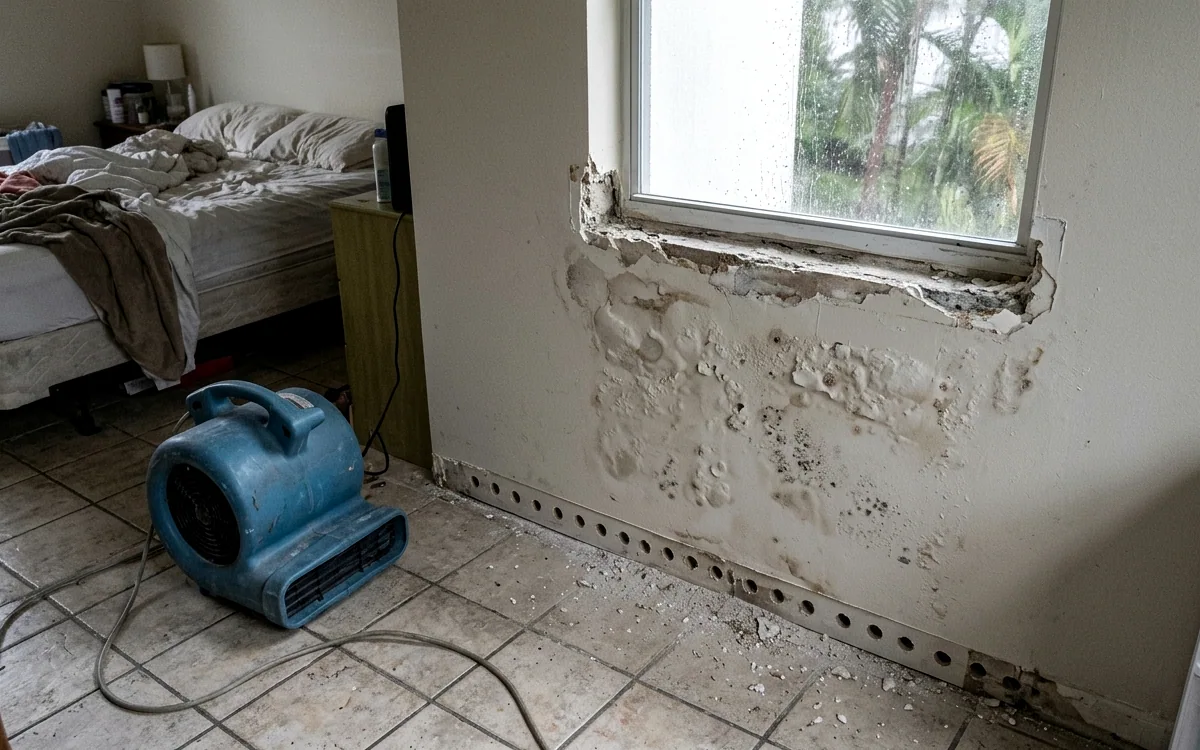
Water that gets past the frame runs down the inside face of the block or the framing behind the drywall. The drywall surface may look only lightly stained while the bottom of the wall cavity stays wet.
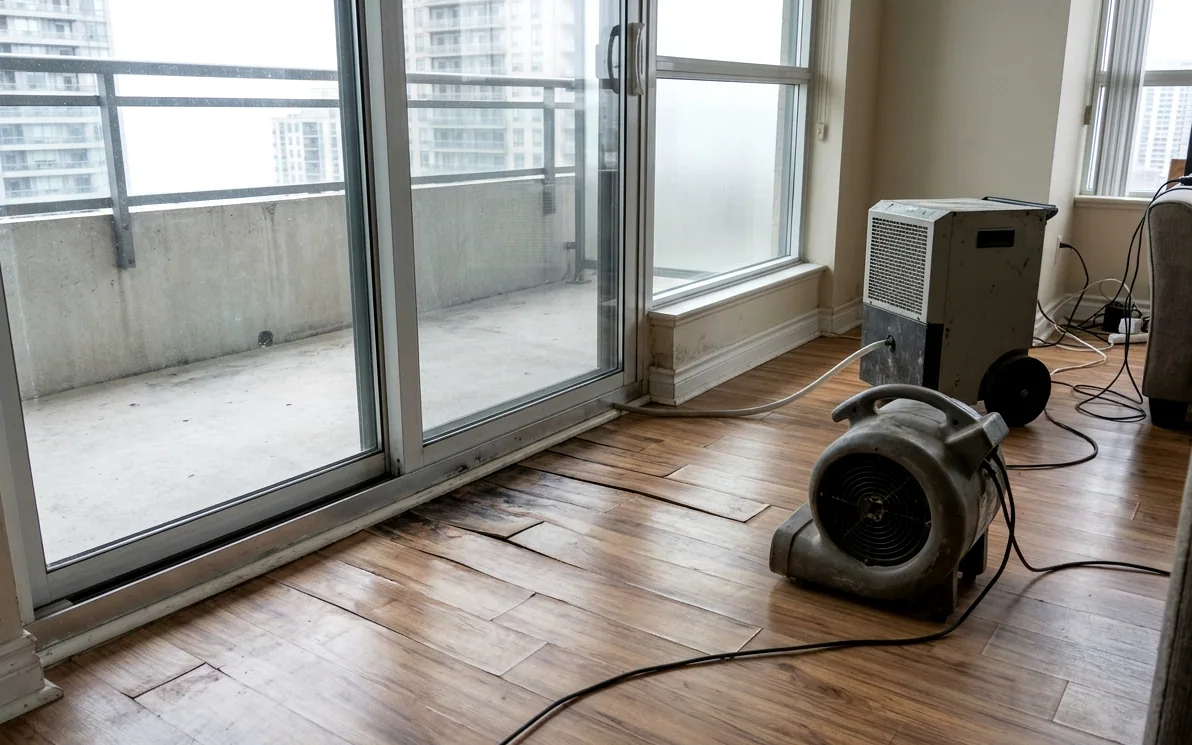
At a slider, the water often runs under the threshold and into the flooring. Wood and laminate near the glass doors take this the hardest.
Drying the wall below the opening
We usually pull the baseboard and the window stool or apron trim so air can reach the wall cavity. Small holes or a narrow cut along the bottom let dry air move through.
If the insulation or drywall has been wet through several storms, it often has to come out. Swollen wallboard that cannot dry in place within 48 hours is removed rather than closed back up.
Repeat leaks and mold
A window that leaks with every storm keeps the wall wet over and over. That is when mold starts to grow on the back of the drywall, often before you see anything on the front.
If our inspection finds growth, we can remove it as part of the job. Any mold sampling is arranged through an independent assessor, kept separate from our work as Florida law requires.
Fixing the leak itself
We dry and repair the damage inside. Resealing the frame, clearing tracks, or replacing a window or slider is work for a window or glazing contractor, and it should be done before the wall is closed up.
Clearing slider weep holes is a quick job you can do yourself between storms with a small brush or a piece of wire.
Miami International Airport sees roughly 67 inches of rain in a typical year, and the wet season from May 15 to October 15 delivers most of it. Miami-Dade also sits in Florida's High-Velocity Hurricane Zone, where wind-driven rain tests every window and slider seal in older homes.
When to call about window leak water damage
Bubbling paint under the sill
Paint that lifts in blisters below a window often has water behind it.
Dark corners on drywall
Stains spreading from the lower corners of a window frame show where water runs down.
Wet floor at the slider
Water on the floor in front of a sliding door after rain points to a track or threshold leak.
Swollen window stool
Wood trim at the base of the window that has swelled or split has taken on water.
Cupping near glass doors
Wood or laminate floor boards that curl up near a slider are absorbing water from the edge.
Musty room after storms
A room that smells damp for days after heavy rain often has a wet wall cavity.
What happens after you call
Inspect after rain
We check the walls, sills and floors around each leaking window with meters and a thermal camera.
Protect the opening
If rain is still coming in, the area is covered and the floor is protected while the leak is stopped.
Open the wall base
Baseboard and trim are pulled and small openings are made so the cavity can dry.
Remove wet materials
Soaked insulation and drywall that cannot be dried are cut out at a clean line.
Dry and monitor
Air movers and a dehumidifier run while we log readings each day until the wall is dry.
Close up after the fix
Once the window is resealed or replaced, drywall, trim and paint are put back.
What window leak water damage usually costs in Miami
A single leaking window is usually a small job, while several leaking sliders after a storm can reach a whole wall of rooms. These are typical Miami-area ranges.
| What is priced | Typical range |
|---|---|
| Rainwater extraction and drying, per sq ft | $3.20 to $3.85 per sq ft |
| Single window, wall cavity dry-out | $170 to $395 |
| Restoration labor, per hour | $78 to $192 |
| Several windows or a slider wall, drying and repair | $1,055 to $2,890 |
The price depends on how many openings leaked, how many storms the wall has been through and whether drywall and flooring need replacing. The final price is set after an on-site look. See every cost range we publish.
Window Leak Water Damage: common questions
Why does my window only leak in some storms?
Wind direction matters. A small gap may stay dry in light rain but let water in when strong wind drives rain straight at that side of the house. That pattern is a strong clue the leak is at the frame or seal.
Can you dry the wall without removing the drywall?
Often yes, if the leak was caught early. Removing the baseboard and drilling small holes at the base lets air reach the cavity. Drywall that has been wet through many storms usually needs replacing.
My condo slider leaks onto the balcony side. Is that the building's problem?
It depends on your association documents and what part failed. We document the damage inside your unit with photos and readings so the association and your insurer can sort out responsibility.
Do impact windows still leak?
They can. Impact glass resists breakage, but the seals and the joint with the wall still age and can let water through, especially if they were not installed and caulked well.
Should I caulk the window myself before you come?
Wait until we have checked the wall. Sealing the outside first is fine to slow new water, but the inside still needs drying, and sealing over wet materials can trap moisture.
Often needed on the same job
Storm & Hurricane Water Damage
Wind-driven rain, surge and roof breaches after tropical weather.
See the serviceWall & Drywall Mold Removal
Mold inside wall cavities and on drywall faces cut out and cleaned.
See the serviceFlood Cuts & Drywall Removal
Wet drywall and baseboards cut out at a clean line so walls can dry.
See the serviceEmergency Tarping & Board-Up
Roof tarps and window boards to stop more water getting in after a storm.
See the serviceWater where it should not be? Call now.
A person answers every call, day or night. Tell us what got wet and when it started, and we will tell you what happens next.