Can wet drywall be saved, or does it need a flood cut?
Wet drywall does not always have to come out. Whether it can be dried in place depends on what kind of water soaked it, how long it has been wet, and what is behind it.
Written from what our crews see on Miami jobs, for homeowners, condo owners and property managers.
At a glance
- Written by
- Winston Albright
- Role
- Guides Editor and Restoration Project Lead
- Updated
- November 2026
- Reading time
- 6 minutes
- Drywall wet with clean water and dried quickly can often stay in place.
- The EPA advises discarding swollen wallboard and wet insulation that cannot be dried within 48 hours.
- Sewage, floodwater, visible mold, swelling or wet insulation usually mean a flood cut.
- A meter reading decides the outcome wall by wall, not the look of the paint.
The short answer
Drywall wet with clean water and caught quickly can often be dried in place. Drywall soaked by contaminated water, wet for days, swollen, crumbling or already growing mold usually needs to be cut out and replaced.
The EPA's guidance for commercial buildings is a useful line: discard wet ceiling tiles, insulation and swollen wallboard that cannot be dried in place within 48 hours. The EPA also advises drying water-damaged areas and items within 24 to 48 hours to prevent mold growth. That time window is the main reason speed matters so much.
On our jobs, the decision is made wall by wall with a moisture meter, not by guessing from how the paint looks.
When drywall can usually be dried in place
The best case is a clean water leak, such as a burst supply line, a sink overflow or a broken ice maker line, that is found and stopped quickly. The drywall is wet but still firm, the paper face is intact, and there is no insulation behind it holding water against the back side.
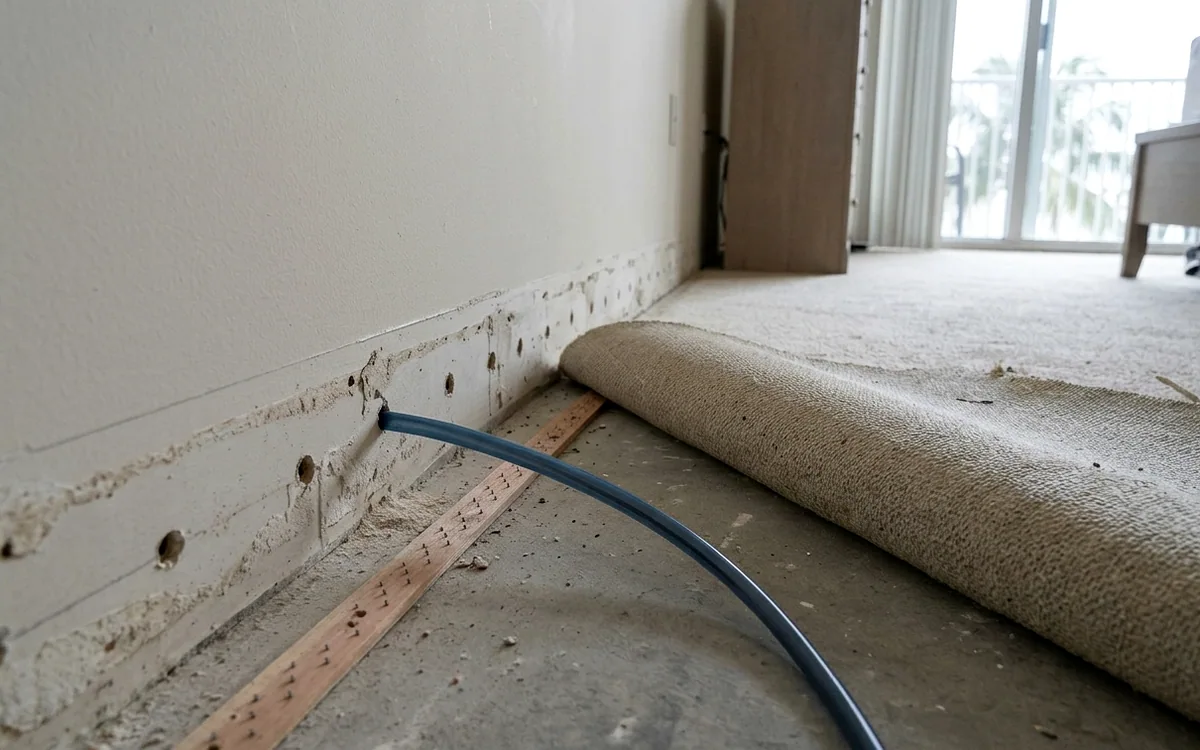
Interior walls in many Miami condos and newer homes are hollow, with no insulation. That helps. Air can be moved into the cavity through small holes drilled behind the baseboard, and the wall can dry from both sides. Removing the baseboard alone often speeds things up a great deal.
Drying in place still takes equipment and time. Air movers are aimed along the wall, dehumidifiers pull water out of the room, and readings are taken every day until the wall matches a dry reference spot.
- Clean water from a supply line, sink or rain
- Found and stopped within a day or so
- Drywall firm, not swollen, sagging or crumbling
- No wet insulation inside the wall
- No visible mold or musty smell
- Readings that drop steadily once drying starts
When it needs to come out
Some conditions make drying in place the wrong choice. Drywall soaked by Category 3 water, such as sewage, toilet backflow from beyond the trap, or floodwater from the street, is generally removed, because the paper face and gypsum core hold contamination that cleaning cannot reach.
Drywall that has been wet for several days, has swollen or softened, or shows mold growth is also usually cut out. So is a ceiling that is sagging under water, since it can fall and is very hard to dry flat. If there is wet batt insulation behind an exterior wall, the drywall usually has to come off to remove the insulation.
Category 2 water, such as washer discharge or AC condensate, sits in between. If it is caught early, drywall can sometimes be cleaned and dried. If it has sat for about 48 hours, it can degrade to Category 3, and removal becomes more likely.
- Sewage, toilet backflow or street floodwater
- Wet for several days before drying started
- Swollen, soft, crumbling or sagging drywall
- Visible mold growth or a strong musty smell
- Wet insulation inside the wall cavity
What a flood cut is
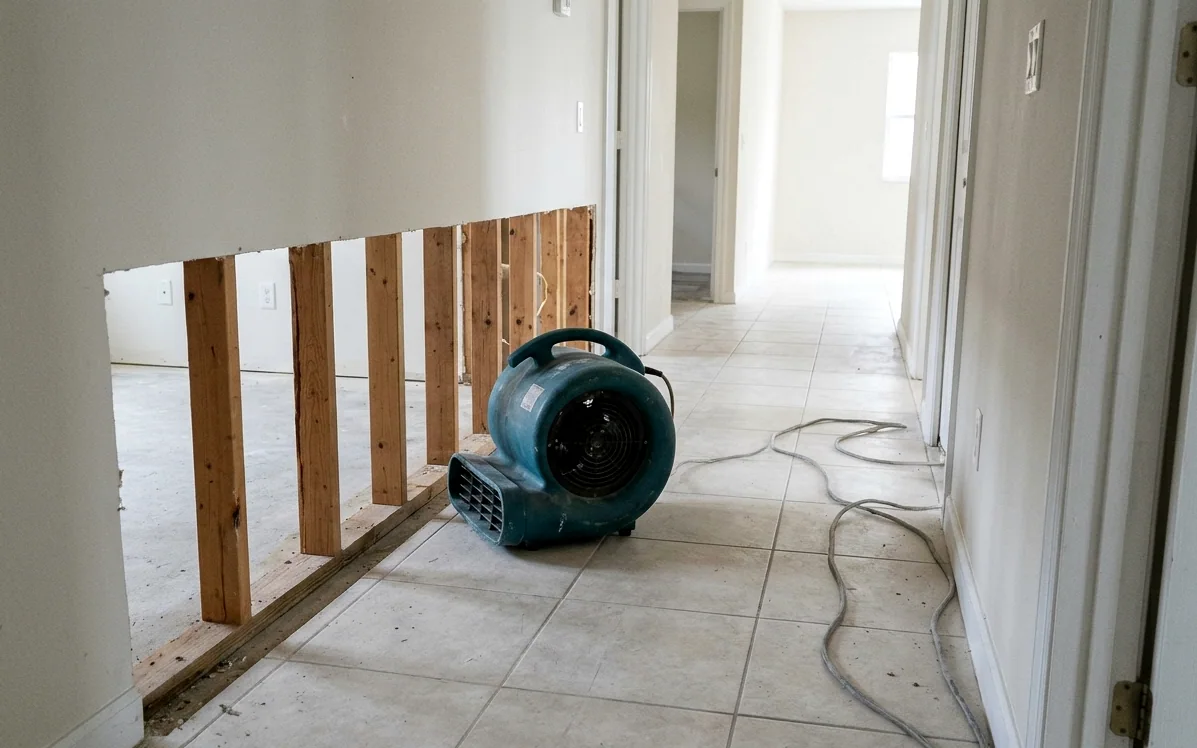
A flood cut is a straight, level cut along the lower part of a wall, removing the wet drywall below it. It is usually made a little above the highest point where the meter shows moisture or the water line shows, so all the wet material comes out in one clean band. The height is set by the readings, so two walls in the same room can be cut at different heights if the water wicked differently.
The cut opens the wall cavity so the studs, the bottom plate and the back of the remaining drywall can dry. It also lets the crew see and clean what is inside the wall. A level, clean line makes the repair much easier, because a new strip of drywall fits neatly and the seam can be finished well.
In Miami, walls on the outside of the house are often concrete block with furring strips and drywall over them. A flood cut there exposes the block, which can hold water for a long time and may need extra drying time before the wall is closed.
Why Miami makes the decision harder
In a dry climate, a wall left alone may slowly give up its water. In Miami, it often will not. Average morning relative humidity runs about 82 percent across the year, so the room air is already close to full. A wet wall can stay wet for a long time unless dehumidifiers bring the air down.
The CDC recommends keeping indoor humidity at or below 50 percent, and notes that mold can grow on drywall, wood and insulation. Drywall paper is one of the first places mold appears after a leak, often on the back side where no one sees it.
That is why we lean toward measuring early and drying hard. A wall that reaches dry in three days is a far better outcome than one that has to be cut out after a week of slowly growing mold.
Cost points the same way. As a general national reference, HomeAdvisor lists per-square-foot restoration at about $3 to $4 for Category 1 water and $7 to $7.50 for Category 3. Every job is priced after an on-site look, but the pattern holds: clean water caught early keeps more of the wall and more of the budget.
What to do with a wet wall right now
Stop the water first, then photograph the wall, the water line and the floor before anything is moved. Pull baseboards off if you can do it without damaging them, and keep them for the adjuster or for reinstalling. Move furniture away from the wall so air can reach it.
Do not paint over a stain or cover the wall with anything. The EPA says moldy surfaces should not be painted or caulked until they are cleaned and dry, and a wet wall sealed with paint or a vinyl covering dries far more slowly. Avoid running a space heater against the wall too, since heat without dry air can push moisture deeper.
Then call us at (786) 947-0034, 24/7. We will read the wall with a meter, tell you which sections can be dried in place and which need a flood cut, and start the equipment so the drywall that can be saved stays in your home.
Reader questions
The paint on my wet wall is not bubbling. Does that mean the drywall is fine?
Not necessarily. Paint can look normal while the gypsum core and back paper are still wet. Bubbling and staining usually show up later. A moisture meter reading along the bottom of the wall tells you how wet it is and how high the water went.
How high up the wall does a flood cut go?
It depends on how high the moisture reached. The cut is usually made a little above the highest wet reading or the water line, so all wet material comes out at once. Many cuts land somewhere between a foot and four feet up, set by the readings rather than a fixed height.
Is it cheaper to dry drywall in place or replace it?
Drying in place is usually cheaper when the wall qualifies, because there is no demolition, new drywall, finishing or painting. When the wall is contaminated, swollen or moldy, replacing it is the right call, and trying to save it can cost more if mold shows up later.
More guides from our crews
AC drain line leaks in Miami condos
In a Miami condo, the air conditioner runs most of the year and pulls gallons of water out of the air. When the small drain line that carries that wat
Read the guideThe first 24 hours after water damage at home
The first day after a leak or flood decides how much of your home can be dried and kept. These are the steps that matter most, in the order we would t
Read the guideFlorida water damage claim deadlines
Florida shortened its property claim deadlines at the end of 2022, and many homeowners still go by the old rules. Here is the general timeline, and th
Read the guideWater where it should not be? Call now.
A person answers every call, day or night. Tell us what got wet and when it started, and we will tell you what happens next.