Commercial water damage cleanup and drying in Miami
Water is spreading across your office, shop or restaurant floor, the business has to open tomorrow, and you need someone on site who can stop it and dry the space properly.
Commercial losses move differently from a house. There are tenants, landlords, property managers and customers to think about, and every hour closed costs money. We plan the drying around how your business runs, then keep records you can hand to whoever needs them.
At a glance
- Service
- Commercial Water Damage
- Group
- Condos & Commercial
- Hours
- Phones answered 24/7
- Office
- 1428 Brickell Avenue, Floor 3, Miami
- Covers
- Miami-Dade and Broward
You call (786) 947-0034 and a project manager asks what failed, how much space is wet and when you operate. A crew comes out with extraction and drying equipment, maps the moisture and sets a plan around your hours. The EPA advises drying within 24 to 48 hours to prevent mold, so call as soon as you find the water.
What we handle in commercial spaces
Most commercial calls come from a burst supply line, a failed water heater, an AC condensate overflow, a sprinkler discharge or rain pushed in through a storefront. We work in offices, retail suites, restaurants, clinics and warehouses, from a single suite to several floors. The approach stays the same: stop the spread, remove the water, dry what can be saved and remove what cannot.
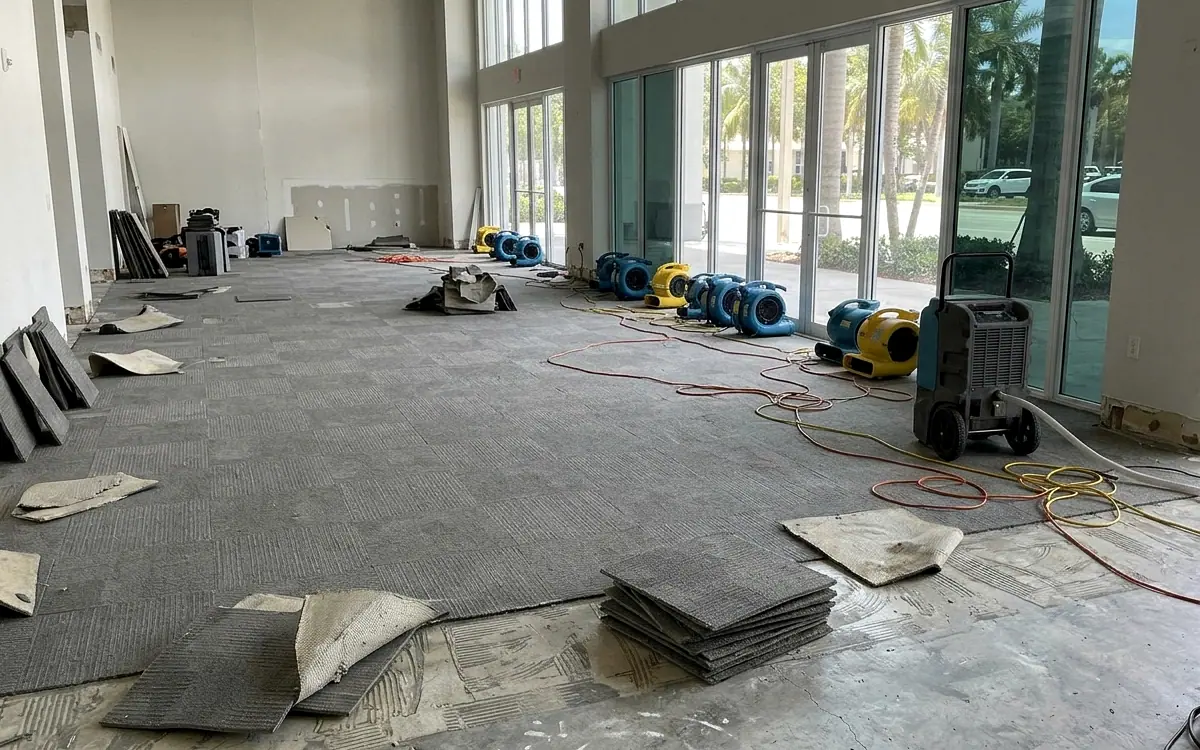
Commercial buildings often have materials homes do not, like dropped ceiling tiles, carpet tiles glued to slab and long runs of drywall partitions. Each one dries differently. The EPA advises discarding wet ceiling tiles, insulation and swollen wallboard that cannot be dried in place within 48 hours, so we check those first.
- Office suites and medical offices
- Retail storefronts and showrooms
- Restaurants and commercial kitchens
- Warehouses and storage spaces
- Lobbies, corridors and common areas
Keeping the business open while it dries
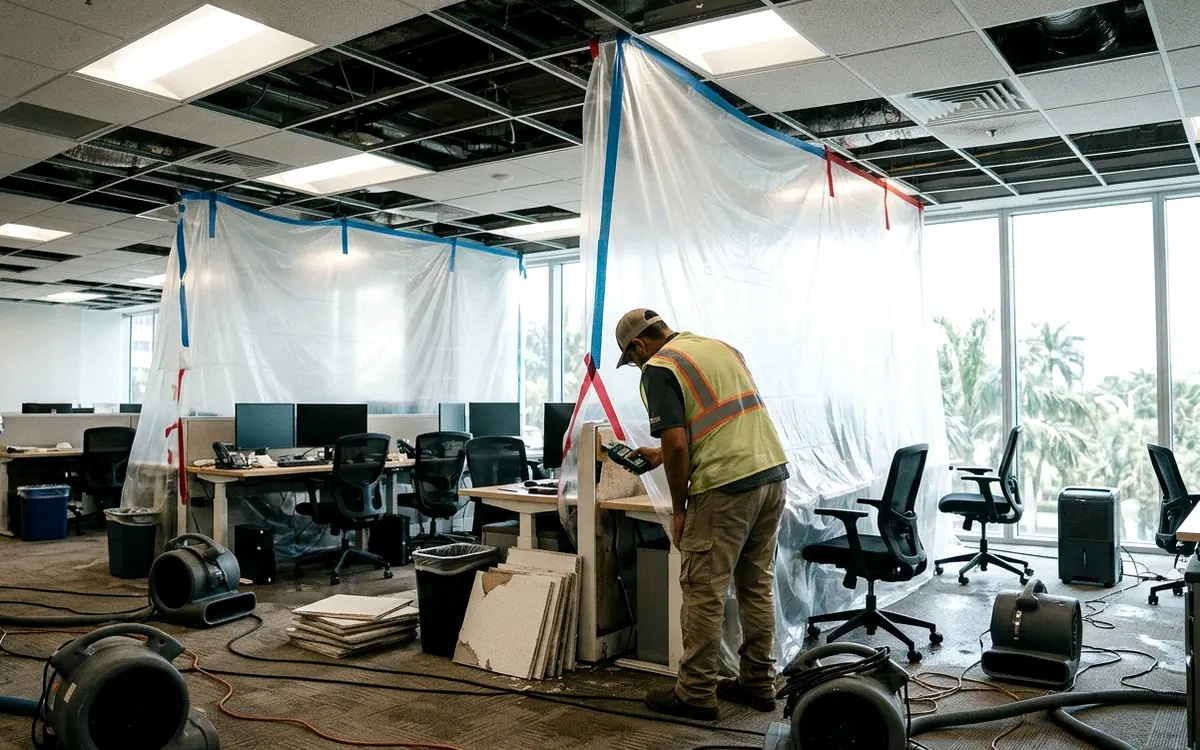
Where we can, we section off the wet area with plastic sheeting and keep the rest of the space working. Equipment is placed to keep walkways clear, and cords are routed and taped so staff and customers are not tripping over them. Loud extraction work can be scheduled before opening or after close.
Drying equipment has to run around the clock to work, so we talk through noise, power draw and security before anything is set up. If the space must stay closed, we tell you plainly how long drying is likely to take and update that estimate as the readings come in.
Water category changes the job
Clean water from a supply line is handled differently from gray or black water. AC condensate and fire sprinkler water are listed as Category 2, and Category 2 water left in a structure for more than about 48 hours can degrade to Category 3. In a restaurant or clinic, that shift matters for what has to be removed and how surfaces are cleaned.
We identify the category on the first visit and write it into the job record. That one call shapes whether carpet tiles stay, how far drywall is cut and what protective steps the crew takes.
Records for owners, tenants and adjusters
A commercial loss often involves more than one party: the tenant, the landlord, a property manager and one or more insurers. We take dated photos, log moisture readings each day and keep an equipment log showing what ran and for how long. Everyone works from the same set of facts.
We can walk the space with the building engineer or the adjuster and explain what we found. We do not decide who pays for what, but we keep the record clear enough that those conversations go faster.
- Dated photos before, during and after
- Daily moisture readings by location
- Equipment placed and days run
- Materials removed and the reason
Finding the source before drying starts
The IICRC S500 standard assumes the property owner is responsible for finding and fixing the water source, though owners may bring in someone to do it. We shut off what we can, trace where the water traveled with meters and thermal imaging, and tell you or your plumber exactly what we found. Drying a space while the leak keeps running wastes your money.
Once the source is stopped, drying can start with confidence. If the building needs a plumber or HVAC contractor, we coordinate timing with them so the work does not stall.
Miami International Airport receives roughly 67 inches of precipitation in a typical year, and the NWS defines the South Florida wet season as May 15 to October 15. During that season dew points in the 70s are an almost daily occurrence, so a wet commercial space will not dry on its own with the doors propped open.
When to call about commercial water damage
Wet carpet tiles
Carpet tiles lifting, squishing or darkening at the seams usually mean water has spread under them across the slab.
Stained ceiling tiles
Brown rings or sagging tiles in a dropped ceiling point to a leak above, often from a pipe, roof drain or AC line.
Sprinkler discharge
Even one head going off puts a lot of water into a suite quickly, and that water counts as Category 2.
Musty back rooms
A damp smell in stockrooms, server closets or behind display walls can mean slow water you have not seen yet.
Water at the storefront
Rain pushed under doors or through glazing during a heavy storm soaks the first few feet of flooring and wall.
Overflowing AC closet
Water around an air handler closet usually means a blocked condensate drain, which also stops the unit from removing humidity.
What happens after you call
Call and triage
We ask what failed, how big the area is, what the space is used for and when you need to operate.
Stop and extract
The crew helps stop the flow if needed and pulls standing water with truck-mounted or portable extraction.
Map the moisture
Meters and thermal imaging show how far water spread under flooring, into walls and across ceilings.
Set up drying
Air movers and dehumidifiers go where they work best and disrupt the business least, sectioned off if needed.
Log every day
We take readings daily, adjust equipment and share progress with whoever you want kept informed.
Confirm dry and pull out
Equipment comes out once materials reach dry targets, and the record is handed over for repairs and the claim.
What commercial water damage usually costs in Miami
Commercial drying is usually priced by area, water category, equipment and labor. These are typical Miami-area ranges, and every job is different.
| What is priced | Typical range |
|---|---|
| Clean water extraction and drying, per sq ft | $4.15 to $5.85 |
| Gray water extraction and drying, per sq ft | $6.20 to $8.65 |
| Desiccant dehumidifier, per unit per day | $157 to $238 |
| Restoration labor, per crew hour | $74 to $187 |
Price moves with the size of the space, the water category, how many layers are wet and how long equipment runs. The final price is set after we look at the space in person. See every cost range we publish.
Commercial Water Damage: common questions
Can we keep operating while the drying equipment runs?
Often, yes. We section off the wet area, place equipment away from walkways and route cords safely. If customers or patients cannot be in the space, we tell you that on the first visit.
Who should call you about a leak in a leased space, the tenant or the landlord?
Either one can call us to stop the damage. We ask who manages the building and who carries coverage for which parts, then keep one shared record so both sides see the same photos and readings.
How do you handle sprinkler water in an office?
Sprinkler water is treated as Category 2, so we extract it quickly and decide what stays based on how long it sat. Ceiling tiles and insulation that cannot be dried in place within 48 hours are usually removed.
What happens to carpet tiles glued to the slab?
Clean water caught early can sometimes be dried with the tiles in place, or the tiles can be lifted and reset. Gray water, or tiles that stayed wet too long, usually means removal so the slab underneath can dry.
Will you coordinate with our building engineer or property manager?
Yes. We can walk the space with them, share daily readings and schedule noisy work or equipment moves around building rules such as elevator use and loading dock hours.
Often needed on the same job
Structural Drying & Dehumidification
Air movers and dehumidifiers set up, logged daily and pulled once dry.
See the serviceEmergency Water Extraction
Truck-mounted and portable extraction to pull standing water out fast.
See the serviceCommercial Mold Remediation
Mold removal in commercial spaces, scheduled around operating hours.
See the serviceInsurance Claim Documentation
Photos, moisture logs and scope notes organized for your adjuster.
See the serviceWater where it should not be? Call now.
A person answers every call, day or night. Tell us what got wet and when it started, and we will tell you what happens next.