Water damage and mold removal across Miami, 33130
Miami sits about 6 feet above sea level, gets roughly 67 inches of rain a year and mixes new condo towers with 1920s bungalows, so leaks, floods and mold show up in every part of the city.
Kelda Restoration runs its own extraction, drying and mold crews out of an office on Brickell Avenue. We work across the whole city, and we keep separate pages for the neighborhoods we cover most, so you can read about the risks on your own street.
At a glance
- Area
- Miami
- From our office
- 1428 Brickell Ave, Floor 3
- Phones
- Answered 24/7
- Most calls
- Water Damage Restoration
Yes, we cover the entire City of Miami, from Edgewater and Downtown south to Coconut Grove and west to Flagami. Most calls here are unit-to-unit condo leaks, storm and street flooding, and mold that follows a slow leak. Call (786) 947-0034 at any hour; a person answers, asks what happened and sends a crew with extraction and drying equipment.
A city of towers, bungalows and mid-century blocks
Miami's housing is split between very new and quite old. About 31 percent of units went up between 2000 and 2019, mostly the high-rise wave in Downtown and Brickell, while about 55 percent were built before 1980. The median year built is 1976.
That mix changes the job. A tower leak usually means a wet ceiling and a neighbor below, while a 1920s house in Shenandoah or Coral Way is more likely hiding a failing cast-iron drain. Roughly seven in ten households rent, so many calls involve a tenant, an owner and sometimes an association at the same time.
How water reaches Miami homes
From outside, it comes from the bay, the sky and the ground. Hurricane Irma pushed 3 to 5 feet of surge along the bay from Downtown to Brickell in September 2017, and king tides flood low streets on dry days from September through November, each event lasting about three hours.
Rain does the rest. About 11 to 12 inches fell in 24 hours on June 3 and 4, 2022, and streets flooded again on April 12, 2023 and on June 11 and 12, 2024. Inside, the usual sources are AC condensate lines, water heaters, washer hoses and old drains, which is why every crew carries moisture meters and a thermal camera.
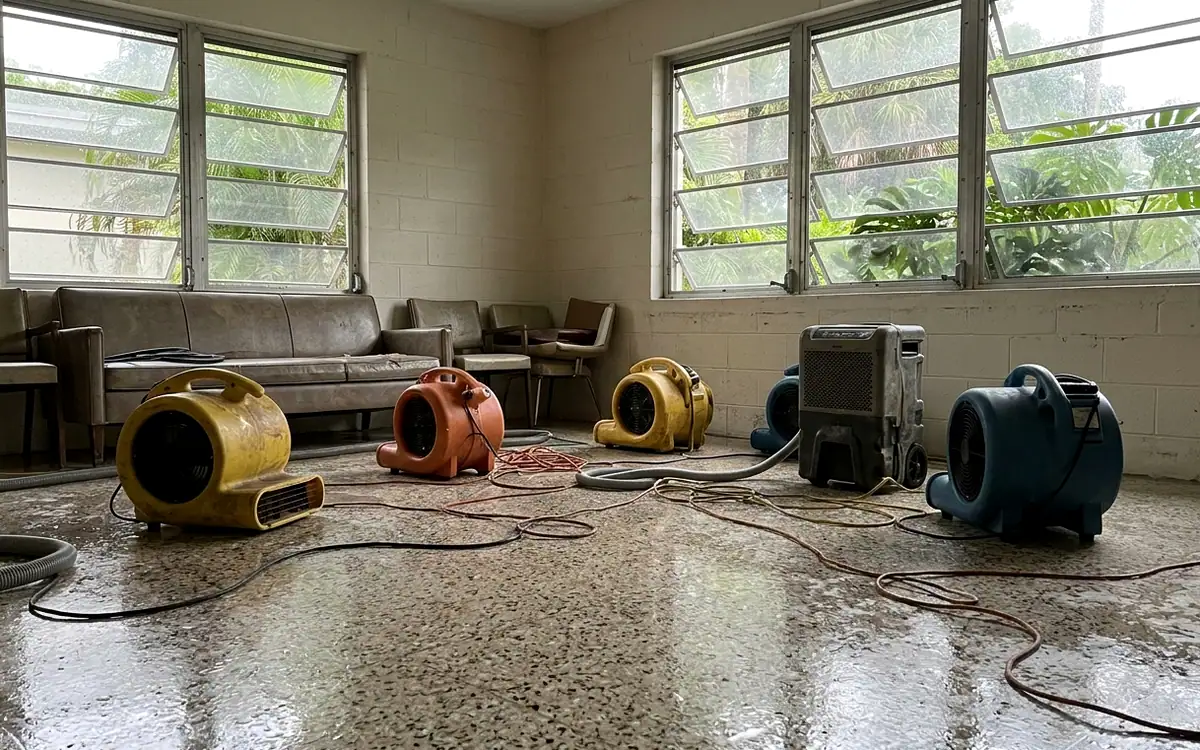
Working across a city this size
Our office at 1428 Brickell Avenue keeps the central neighborhoods close, and the crew lead plans each visit around the building and the damage. In towers, we book the service elevator and loading dock with management before we arrive. In single-family homes, we walk the house, find the wet areas and start extraction.
Every job starts with a moisture map, then extraction, then drying that we log daily until readings reach dry standard. The work follows the drying approach in the IICRC S500 standard. When mold is involved, testing goes through an independent assessor and lab, and our crew handles containment and removal.
Neighborhood pages and the cities around Miami
This site has its own page for Brickell, Downtown Miami, Edgewater, Coconut Grove, Coral Way, Little Havana, Flagami, West Flagler, Allapattah, Little Haiti, Upper Eastside, Shenandoah, The Roads and Liberty City. Each one covers the housing and the water problems that come up there most.
Past the city line, our crews also work in Miami Beach, Coral Gables, Hialeah, Miami Shores and Key Biscayne, along with the rest of Miami-Dade County and Broward County. The phone number is the same everywhere: (786) 947-0034.
Where water and mold start in Miami
Low ground, wide floodplains
Most Miami neighborhoods sit about 6 feet above sea level, and roughly 40 percent of the city's homes are in floodplains.
Fall king tides
The city says king tides flood streets on dry days every September through November, with each event lasting about three hours around peak tide.
Cloudburst flooding
About 11 to 12 inches fell in 24 hours on June 3 and 4, 2022. The city runs 13 stormwater pump stations and adds temporary pumps at trouble spots.
Pre-1975 drain lines
Homes built before 1975 typically have cast-iron drains, which rust and narrow inside and can leak into slabs and walls.
Services we run most in Miami
Water Damage Restoration
Extraction, drying and repair after any water event in a home or unit.
See the serviceCondo Water Damage
Unit-to-unit leaks in high-rises, worked alongside building management.
See the serviceFlood Damage Cleanup
Rising water and street flooding cleaned out, with flood cuts where needed.
See the serviceMold Removal
Containment, removal and cleaning of mold, with the moisture source fixed.
See the serviceAC Drain Line Leak Damage
Clogged condensate lines and air handler overflows that soak floors and walls.
See the serviceStorm & Hurricane Water Damage
Wind-driven rain, surge and roof breaches after tropical weather.
See the serviceMiami: questions we hear
Do you cover every neighborhood in the City of Miami?
Yes. Our crews work across the whole city, from Edgewater and the Upper Eastside to Coconut Grove, Flagami and Liberty City. If your street is inside Miami, call (786) 947-0034 and we will send a crew.
Will my homeowners policy pay for flood water in my Miami home?
Often not. FEMA notes that most standard homeowners policies do not cover flood damage, which needs a separate flood policy. A burst pipe or appliance leak is a different kind of loss, so tell your carrier exactly where the water came from. We record the source with photos and moisture readings.
How soon can mold start after a leak in Miami's humidity?
The EPA advises drying wet materials within 24 to 48 hours to prevent mold growth, and Miami mornings average about 82 percent relative humidity. Damp drywall here rarely dries on its own, so we set up dehumidifiers on the first visit instead of waiting.
Is there a busy season for water damage in Miami?
Yes. The National Weather Service puts the South Florida wet season at May 15 to October 15, June is normally the wettest month, and hurricane season peaks around September 10. King tides add fall flooding on top of that. We answer every day of the year, but those months keep crews busiest.
Other places our crews cover
Water damage in Miami? Call our crew lead.
A person answers every call, day or night. Tell us what got wet and when it started, and we will tell you what happens next.