Water damage and mold removal in Miami, by our own crews
A burst supply line, an overflowing AC pan or a leak from the unit upstairs can soak floors, walls and ceilings in minutes, and Miami air keeps that water from drying on its own.
We pull out the water, dry the structure with our own equipment and remove mold at the source. Call any hour and a person picks up.
- Shut off the water at the main valve
- Turn off power to wet rooms
- Move rugs and furniture off wet floors
- Take photos before anything is moved
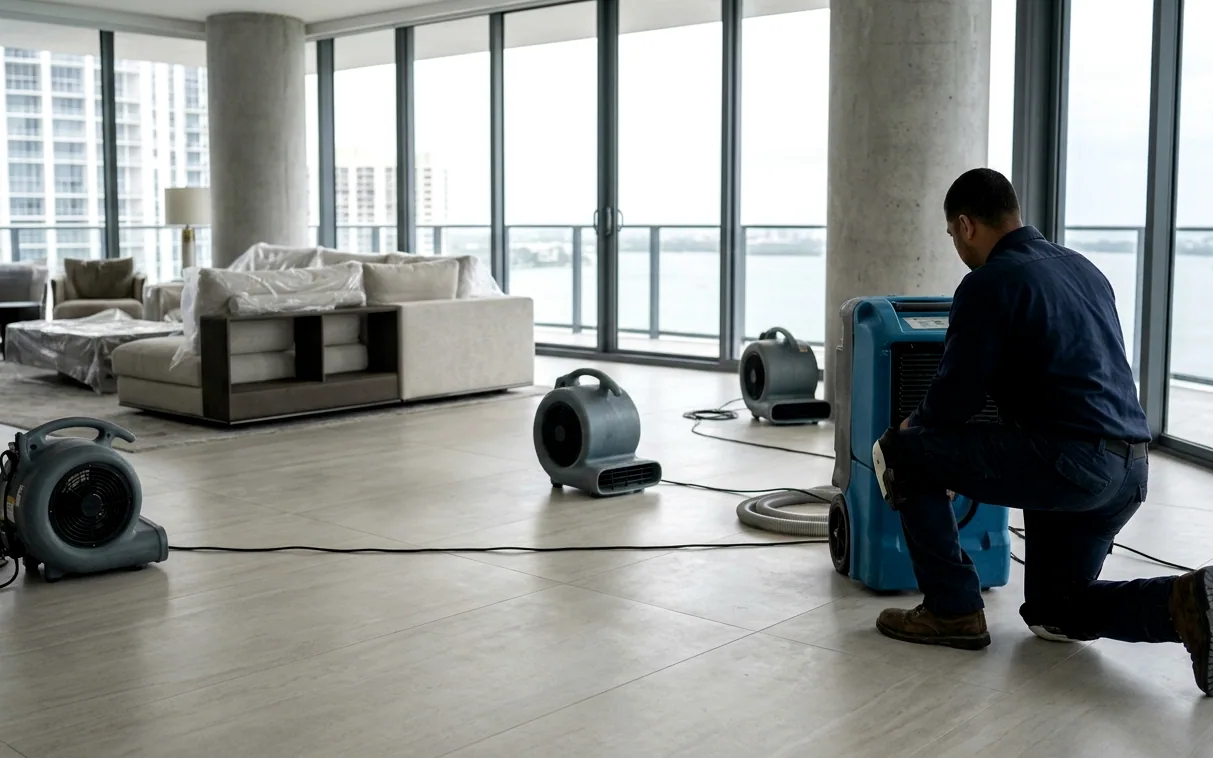
If water is inside your Miami home or condo unit, stop the source, keep clear of wet outlets and call us. We extract standing water, map the moisture with meters and thermal imaging, then set up air movers and dehumidifiers and log readings every day until the materials are dry. The EPA advises drying within 24 to 48 hours to keep mold from starting, so speed matters most.
Water here does not dry out by itself
Water in a Miami home rarely stays where it landed. It runs under tile, wicks up drywall and settles into the slab, and the air here keeps it from leaving. Morning humidity averages about 82 percent across the year, and the airport records roughly 67 inches of rain in a typical year. That is why we treat every call as a drying job first and a cleanup second.
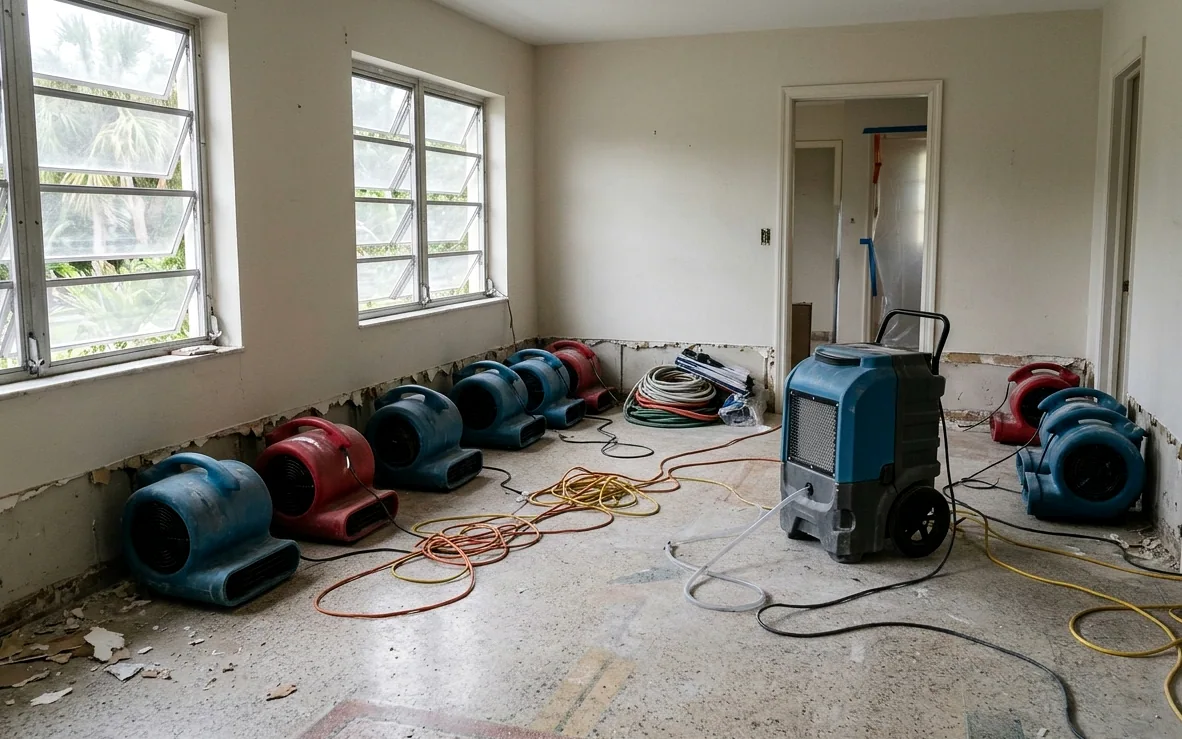
Our crews work out of an office on Brickell Avenue and cover Miami, the rest of Miami-Dade and much of Broward. The housing mix shapes how we set up. About 55 percent of the city's homes were built before 1980, many of them concrete block on a slab with terrazzo or tile underfoot, while about 31 percent went up between 2000 and 2019 during the downtown and Brickell high-rise wave. At Kelda Restoration we plan a slab leak in a 1950s ranch house very differently from a ceiling leak on the 30th floor.
Every job runs on readings, not guesses. We map moisture on the first visit, log it every day, and pull equipment only when the numbers say the materials are dry. Mold work follows the same rule: find it, contain it, remove it and fix the water behind it. Any mold testing goes through an independent assessor, and you get the photos, logs and notes your adjuster will ask for.
What happens hour by hour after water gets in
Water damage gets worse on a clock. Here is what a wet room in Miami usually goes through if nobody dries it.
Water spreads and soaks in
Water runs under baseboards, into carpet pad and through ceiling drywall. Stopping the source and calling now keeps the wet area as small as it will ever be.
Drywall and wood swell
Drywall softens, baseboards and cabinet bases swell and wood floors begin to cup. Extraction and drying started in this window save the most material.
Mold window opens
The EPA advises drying wet areas within 24 to 48 hours to prevent mold. In Miami humidity, damp drywall and carpet pad can start to smell musty in this stretch.
Water quality drops
Gray water left in a structure for more than about 48 hours can degrade to black water. Wallboard and insulation that could not be dried in place usually have to come out.
Mold and tear-out grow
Mold growth becomes likely, odors settle into the structure and more drywall, pad and trim need removal. The job gets longer and the repair list gets bigger.
Water damage and mold services
From the first gallon pulled off the floor to the last piece of trim put back, these are the jobs our crews handle across Miami homes, condo units and businesses.
Water damage
Water Damage & Flooding
Leaks Inside the Home
Mold, condos and after-care
Mold Removal
Condos & Commercial
Signs of hidden water or mold
Some leaks never show up as a puddle. If you notice any of these, the water is probably inside a wall, ceiling or floor already.
A musty smell that keeps coming back
A damp, earthy odor in a closet, bathroom or AC closet usually means wet material and early mold growth somewhere close by.
Ceiling stains or sagging drywall
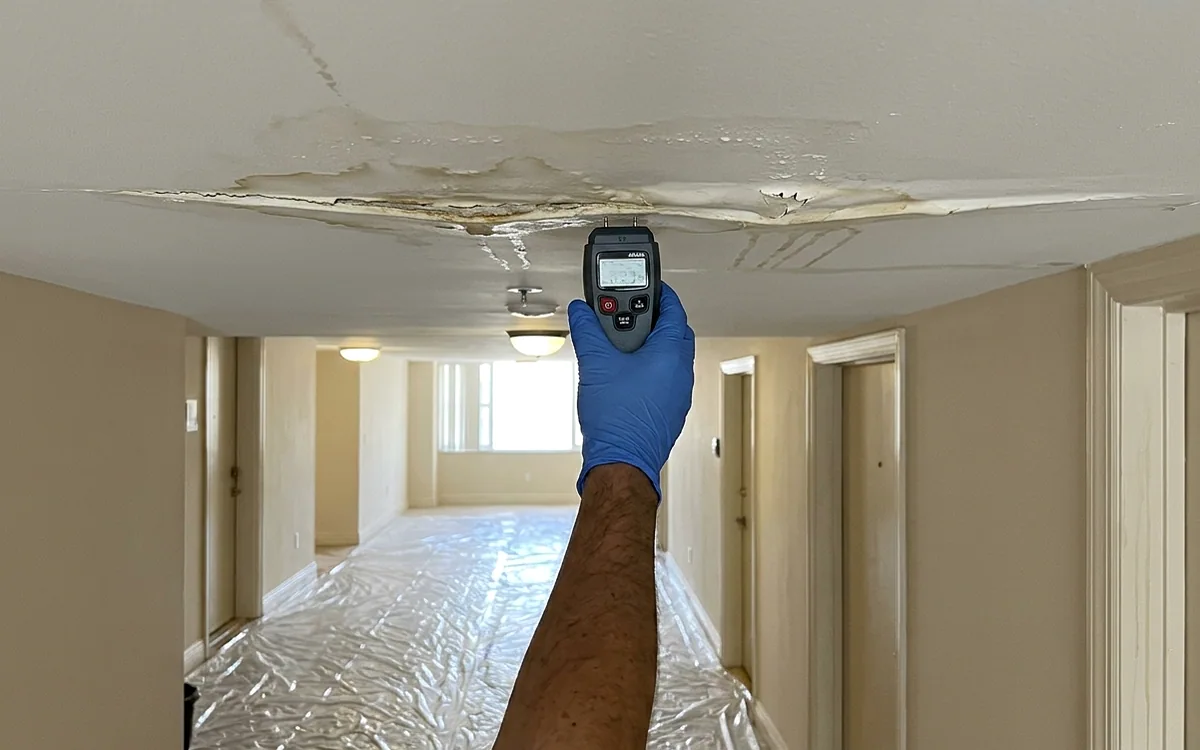
Yellow or brown rings, bubbling paint or a soft spot overhead point to a leak from a roof, an AC unit or the unit above.
Swollen baseboards and peeling paint
Baseboards that split or pull away and paint that blisters near the floor show water wicking up the wall from below.
Tile that lifts or sounds hollow
Cracked grout, loose tile or warm spots on a slab floor can mean a slab leak pushing water up from underneath.
Wet floors around the air handler
Water around the AC closet or a damp carpet near it often comes from a clogged condensate drain line.
A water meter that moves when nothing runs
If every faucet and appliance is off and the meter still turns, water is escaping from a line you cannot see.
How a water damage job runs
Every job follows the same order, so you always know what comes next and why.
You call, a person answers
We ask what happened, where the water came from and which rooms are wet, then tell you what to do until the crew gets there.
Arrival and moisture map
The crew checks for safety, then traces the wet area with moisture meters and thermal imaging so nothing hidden gets missed.
Water extraction
Truck-mounted or portable extractors pull standing water out of floors, carpet and pad before drying starts.
Drying setup
Air movers and dehumidifiers go in, sized to the rooms and materials. Wet drywall is cut out at a clean line where it cannot be saved.
Daily readings
We come back to take readings, record them in a drying log and move equipment where the numbers say it is needed.
Removal and repair
Once readings show the materials are dry, equipment comes out and we put back drywall, baseboards, paint and trim.
High-rise condo leaks in Miami
Miami-Dade has about 313,352 condo units, and a leak in one of them rarely stays put. Water from a failed supply line, a water heater or an AC overflow can travel through a slab penetration into the unit below and then the one under that. We work with building management to find where the water started, get access to every affected unit and keep hallways and elevators clean while equipment moves in and out.
Who pays for what usually follows the condo documents and Florida law. In general terms, the association covers the building as it was originally installed, including much of the drywall, while the unit owner's policy covers finishes, fixtures, appliances, cabinets and countertops inside the unit. We keep separate photos and moisture logs for each unit, so the association, each owner and each adjuster can see their part of the damage.
- Separate moisture logs for every affected unit
- Work scheduled with building management and security
- Floor protection on hallway and elevator routes
- Photos marked by unit for each adjuster
Why mold moves fast in Miami
Mold needs moisture, and Miami supplies plenty of it. Dew points in the 70s are an almost daily event during the wet season, and indoor humidity climbs fast when an AC drain clogs or a leak keeps a wall damp. The EPA advises drying wet materials within 24 to 48 hours to prevent mold, and in this climate growth on drywall, carpet pad or cabinet backs can start inside that window.
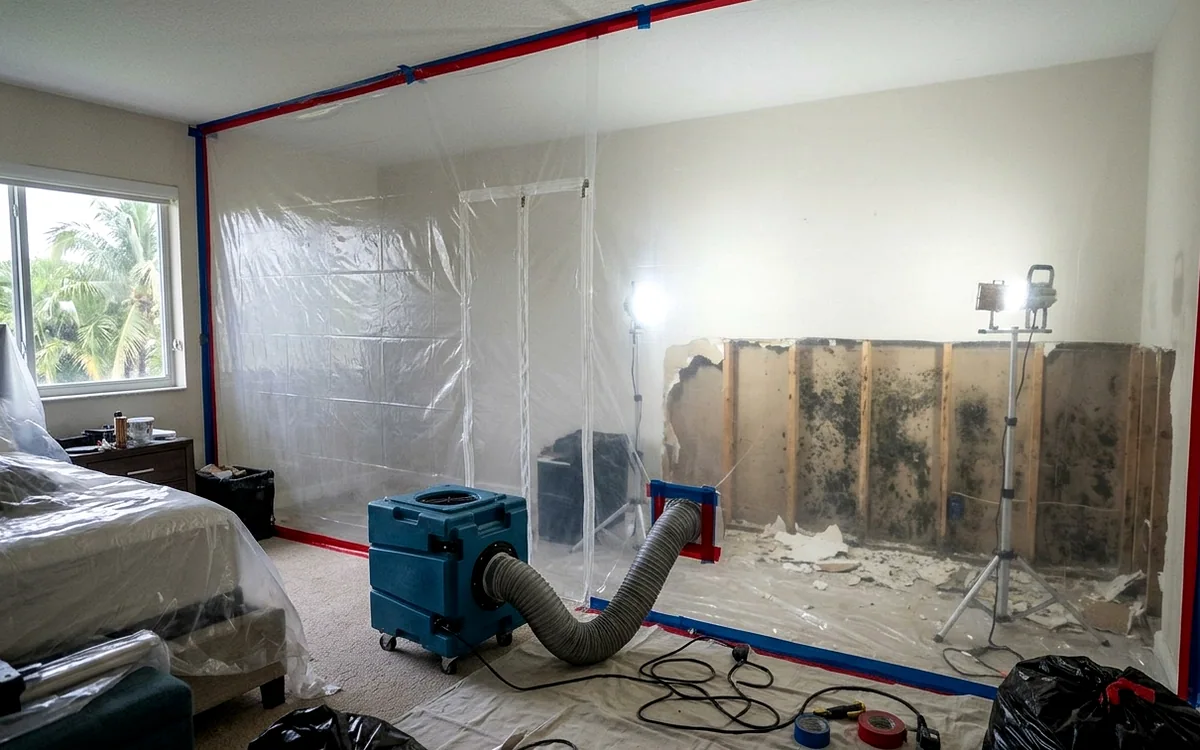
Cleaning mold without fixing the water behind it usually lets it come back, so every removal job starts by finding the moisture source. We set up containment with plastic sheeting and HEPA air scrubbers, remove what cannot be cleaned and dry the area out. When you want air or surface samples, or a clearance check after the work, we arrange it through an independent assessor and lab, so the results come from someone other than the crew that did the removal.
Why Miami homeowners call us
A person answers 24/7
Leaks do not wait for business hours. Day, night or holiday, a real person picks up and starts sorting out your call.
Our own drying equipment
Extractors, air movers and dehumidifiers belong to us and ride on our trucks, so the setup is not waiting on a rental counter.
Moisture readings logged daily
Every visit adds readings to a written drying log, so you can see the materials getting drier and know why equipment stays or goes.
Photos and logs for your adjuster
We photograph the damage, record the readings and write up the scope, then hand it over in an order your adjuster can follow.
Areas we cover across Miami-Dade and Broward
From Brickell, Little Havana and Coconut Grove to Miami Beach, Hialeah, Kendall and north into Fort Lauderdale and Hollywood, our crews cover 53 neighborhoods, cities and counties around our Brickell office.
Check how serious your water damage is
Pick where the water came from, how long things have been wet and which materials got soaked. The check gives you a likely water category and a risk reading for mold and material loss, so you know how urgent the call is.
Where the water came from, how long it has been wet, and which materials got soaked. It returns the likely water category, a mold risk reading and the services that fit.
Guides from our drying jobs
Plain answers on leaks, drying, mold and insurance paperwork, written by Winston Albright from what our crews see in Miami homes and condo units.
AC drain line leaks in Miami condos
In a Miami condo, the air conditioner runs most of the year and pulls gallons of water out of the air. When the small drain line that carries that wat
Read the guideCan wet drywall be saved after a leak?
Wet drywall does not always have to come out. Whether it can be dried in place depends on what kind of water soaked it, how long it has been wet, and
Read the guideThe first 24 hours after water damage at home
The first day after a leak or flood decides how much of your home can be dried and kept. These are the steps that matter most, in the order we would t
Read the guideQuestions Miami callers ask first
How fast can a crew get to my home?
We send the nearest available crew as soon as the call ends, and arrival depends on traffic, weather and how many emergencies are open that night. We will tell you an honest window on the phone rather than a promise we cannot keep.
How much does water damage restoration cost in Miami?
National figures put most water damage jobs between about $1,382 and $6,357, with small clean-water jobs far lower and large sewage or flood jobs higher. Your price depends on the water category, the size of the wet area and the materials, and we give a final number after an on-site look.
Will my insurance pay for water damage?
Sudden leaks such as a burst pipe or failed supply line are often covered by homeowners or condo policies, while flood from rising water usually needs a separate flood policy. In Florida a new claim must be reported within 1 year of the date of loss, so call your insurer early. We supply the photos, moisture logs and scope notes.
Water is coming into my condo from the unit above. What do I do?
Call building management or security so they can find the source and shut it off, then call us. We dry your unit, document the damage separately from your neighbor's, and work with management for access to the units involved.
Do I need mold removal after a leak?
Not always. If the area is dried within 24 to 48 hours, mold often never gets started. If a musty smell, staining or visible growth shows up, we inspect, find the moisture behind it and remove the mold under containment.
Do you remove standing water at night?
Yes. Extraction is the first thing we do on an emergency call, at any hour. Getting standing water out quickly limits how far it soaks into walls, cabinets and floors.
Which areas do you serve?
We cover the City of Miami and its neighborhoods, cities across Miami-Dade such as Miami Beach, Coral Gables, Hialeah, Doral and Kendall, and Broward cities including Fort Lauderdale, Hollywood, Pembroke Pines and Miramar.
Water in your home right now? Call us.
Call (786) 947-0034 any hour of any day. Tell us what happened and which rooms are wet, and we will tell you what to do while the crew is on the way.
- Phone
- (786) 947-0034
- Hours
- Phones answered 24 hours a day, 7 days a week
- Office
- 1428 Brickell Avenue, Floor 3, Miami, FL 33131
- Coverage
- Miami, Miami-Dade County and Broward County
Water where it should not be? Call now.
A person answers every call, day or night. Tell us what got wet and when it started, and we will tell you what happens next.