Mold inspection vs mold testing in Florida: what each one tells you
People often use mold inspection and mold testing as if they meant the same thing. They answer different questions, and in Florida the law also shapes who can do which part of a job.
Written from what our crews see on Miami jobs, for homeowners, condo owners and property managers.
At a glance
- Written by
- Winston Albright
- Role
- Guides Editor and Restoration Project Lead
- Updated
- November 2026
- Reading time
- 6 minutes
- An inspection finds moisture, growth and its cause; testing reports what is in a sample.
- Florida's Section 468.8419 keeps assessment and remediation on the same structure apart for 12 months.
- The CDC does not recommend routine home mold testing because there are no official standards for acceptable levels.
- Testing is most useful for documentation and for independent clearance after remediation.
Two different questions
A mold inspection asks: where is the moisture, where is the growth, and what is causing it? It is a hands-on look at the home, with tools that find water you cannot see. The result is a map of the problem and its source.
Mold testing asks a narrower question: what is in a sample of air or a surface, and how much of it? Someone collects samples, a lab analyzes them, and the report lists spore types and counts. Testing does not, by itself, find the leak or tell you which wall to open.
Both have a place. Knowing which question you actually need answered saves money and time, and it keeps the focus on the moisture problem, which is what lets mold grow in the first place.
What a mold inspection involves
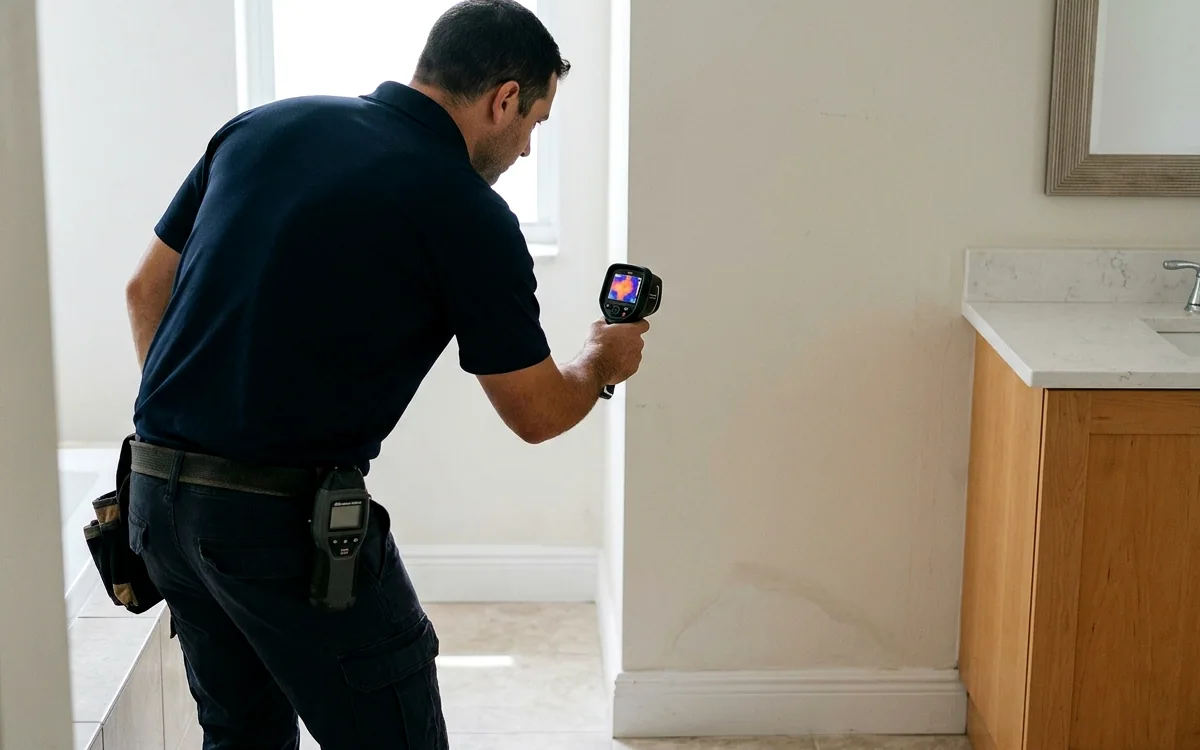
On our jobs, a mold inspection is a visual walk-through backed by a moisture meter and thermal imaging. We look where mold usually starts in Miami homes: under sinks, behind toilets and vanities, in AC closets, along baseboards near bathrooms, in closets on exterior walls and in attics under roof leaks.
Thermal imaging shows temperature differences that often point to wet areas behind drywall or under flooring. The meter then confirms whether those spots are actually wet. Together they help trace a stain on a ceiling back to a shower pan, a supply line or an AC drain.
The output is practical: where the growth is, roughly how large it is, what is feeding it, and what it would take to fix. That is what most homeowners need when they see spots or smell must.
An inspection also catches the cases where there is moisture but no growth yet. A wet baseboard behind a washer or a damp cabinet floor under a dishwasher can be dried before mold ever starts, which is far cheaper than removing it later. As a general national reference, HomeGuide prices a mold inspection at about $300 to $650 for an average home, and Fixr lists a standalone inspection at about $450 to $800. Your price depends on the size of the home and what we find.
- Visual check of likely problem areas room by room
- Moisture meter readings on drywall, wood and flooring
- Thermal imaging to spot hidden wet areas
- Tracing the water source behind the growth
- A clear plan for what needs to be dried or removed
What mold testing involves
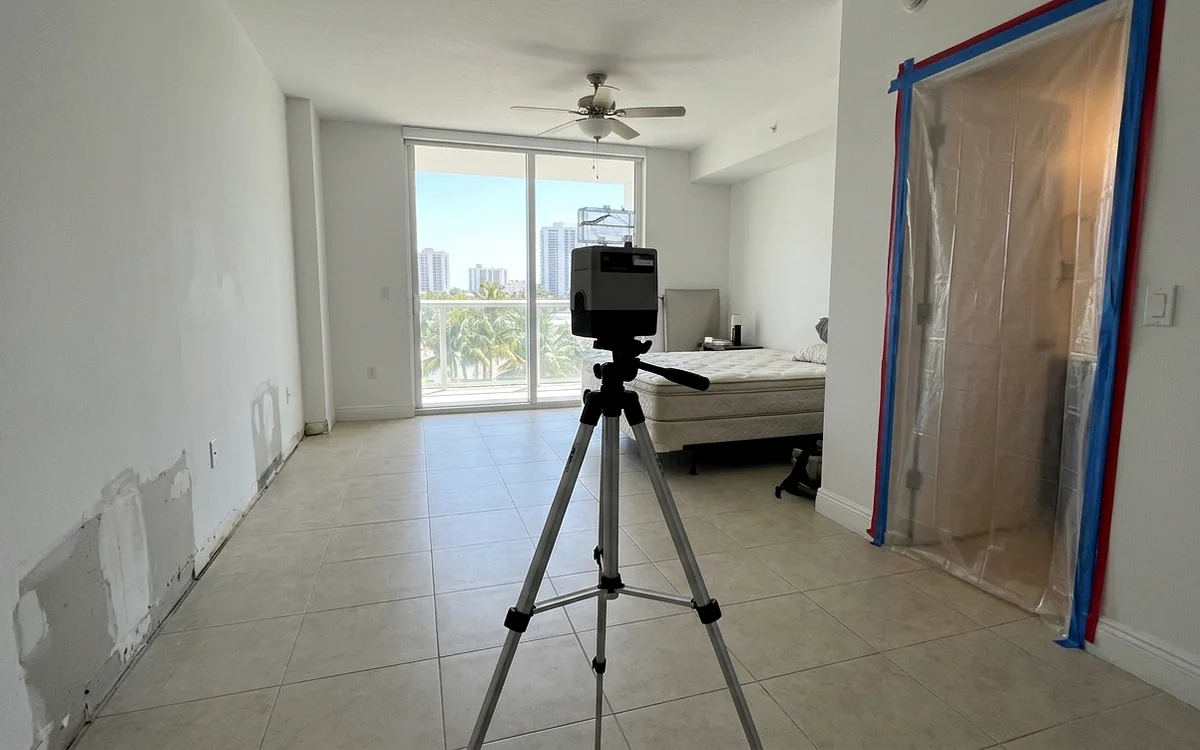
Mold testing collects samples for a lab. Air samples are drawn through a cassette with a small pump, usually inside the home and outside for comparison. Surface samples are taken with tape lifts or swabs from a visible spot. The lab then identifies the types of mold present and how much.
Testing is useful in specific situations: a sale or lease that calls for documentation, a dispute over whether a problem exists, a health concern where a doctor has asked for data, or a check after remediation to confirm the area is clean before walls are closed.
When testing is needed on a project where we handle the removal, we arrange it through an independent assessor and lab. That keeps the sampling separate from the company doing the remediation, which is how Florida law sets it up.
Why Florida keeps assessment and remediation apart
Florida's mold-related services law, Chapter 468, Part XVI, defines mold assessment and mold remediation as work involving mold growth greater than 10 square feet. Section 468.8419 then separates the two roles on the same structure.
Under that section, a mold assessor or the assessor's company may not perform or offer remediation on a structure it assessed within the previous 12 months. In the same way, a mold remediator or its company may not perform or offer an assessment on a structure it remediated within the previous 12 months. The statute includes a narrow exemption tied to Section 489.105(3).
Most homeowners never see this rule in action until they ask a company to both test and fix. The point is to avoid a conflict of interest. The party that samples and writes the protocol is not the party that profits from the removal, and the party that removes the mold is not the one who signs off that it is gone. For you, that means the clearance result comes from someone with no stake in the outcome.
What the CDC says about testing at home
The CDC does not recommend routine mold testing at home. It notes there are no official standards for acceptable mold levels, so a lab number on its own does not tell you whether a home is safe. Instead, the CDC advises removing visible mold and fixing the moisture source.
That view lines up with the EPA, which says the key to mold control is moisture control. If you can see mold or smell it, and you know there was a leak, testing to confirm that mold exists usually adds cost without changing what needs to happen next.
Where testing does earn its cost is in clearance after a remediation job, and in cases where the source is unclear and a documented baseline is needed. Your situation decides which applies. In most Miami homes we see, the leak and the wet materials are the story, and the lab report adds little to it.
Choosing the right first step
If you see growth, smell mustiness, or had a recent leak, start with an inspection. It finds the moisture and the extent of the problem, and it tells you whether you are looking at a small cleanup or a larger job. The EPA says most people can clean a moldy area under about 10 square feet themselves.
If you need documentation, such as for a sale, a landlord dispute or clearance after remediation, plan on independent testing as well. Keep the two roles separate, and ask any company you call how they handle that split.
Call us at (786) 947-0034, 24/7, to set up a mold inspection in your Miami home or condo. If sampling or clearance testing is needed, we will arrange it through an independent assessor and lab.
- Visible spots or a musty smell: start with an inspection
- Recent leak, no visible mold yet: moisture check first
- Sale, lease or dispute: plan on independent testing
- After remediation: independent clearance before walls close
Reader questions
I can see mold under my sink. Do I need a test before anything else?
Usually not. The CDC advises removing visible mold and fixing the moisture source rather than testing to confirm it is there. An inspection to find the leak and how far the growth goes is the more useful first step.
Why can't the same company test my home and then remove the mold?
Florida's Section 468.8419 bars an assessor from remediating a structure it assessed within 12 months, and a remediator from assessing a structure it remediated in that time. The rule keeps the person judging the problem separate from the person paid to fix it.
My landlord wants proof the mold is gone. What kind of report is that?
That is usually a clearance or post-remediation check done by an independent assessor, often with air or surface samples sent to a lab. It is separate from the removal work, and it is done after the area is cleaned and dry but before walls are closed.
More guides from our crews
AC drain line leaks in Miami condos
In a Miami condo, the air conditioner runs most of the year and pulls gallons of water out of the air. When the small drain line that carries that wat
Read the guideCan wet drywall be saved after a leak?
Wet drywall does not always have to come out. Whether it can be dried in place depends on what kind of water soaked it, how long it has been wet, and
Read the guideThe first 24 hours after water damage at home
The first day after a leak or flood decides how much of your home can be dried and kept. These are the steps that matter most, in the order we would t
Read the guideWater where it should not be? Call now.
A person answers every call, day or night. Tell us what got wet and when it started, and we will tell you what happens next.