King tides and street flooding in Miami: what they mean for your home
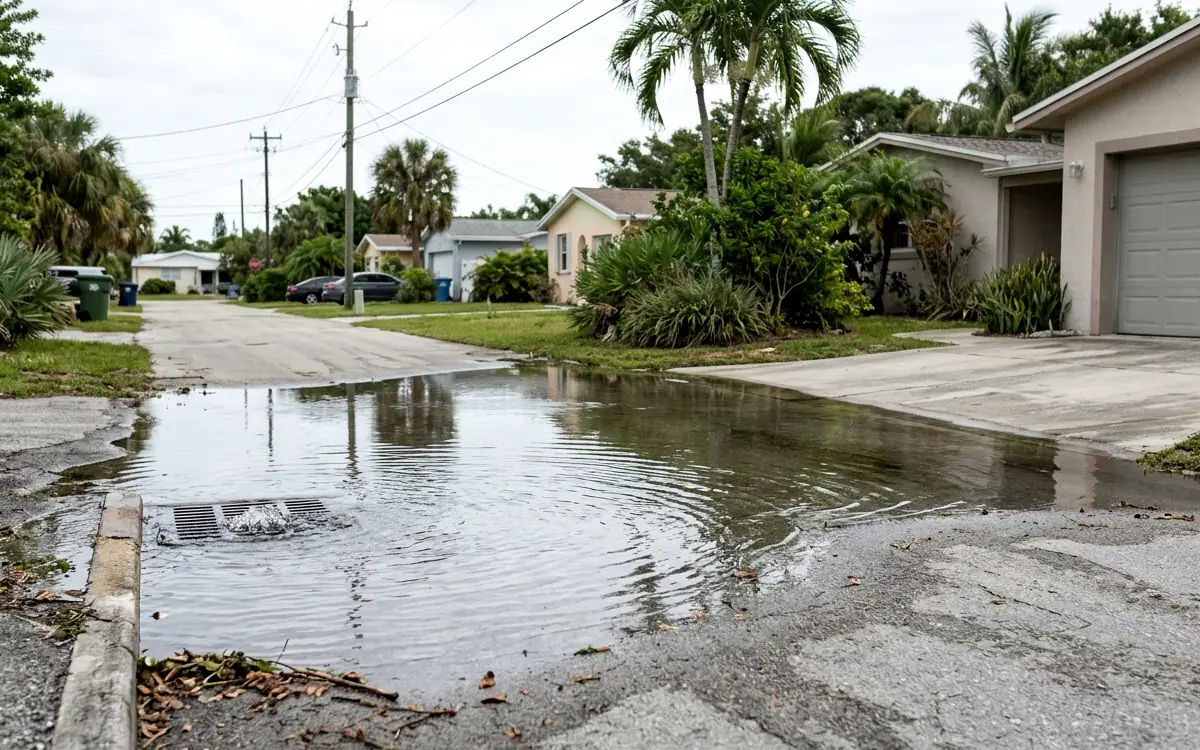
On a clear fall morning, salt water can bubble up through storm drains and spread across low Miami streets with no rain at all. For homes and garages on those streets, king tide season is a yearly water risk worth planning around.
Written from what our crews see on Miami jobs, for homeowners, condo owners and property managers.
At a glance
- Written by
- Winston Albright
- Role
- Guides Editor and Restoration Project Lead
- Updated
- November 2026
- Reading time
- 6 minutes
- King tides are the year's highest predicted tides and are most noticeable in South Florida in the fall.
- Low coastal streets flood on sunny days when tidal water backs up through storm drains.
- Garages and low thresholds take the most risk, especially from car wakes and stored items on the floor.
- Tidal floodwater is treated as contaminated, so wet drywall and porous items it touched are usually removed.
What a king tide is
King tides are the highest predicted high tides of the year. They are also called perigean spring tides, because they happen when the moon is closest to the Earth and lines up with the sun, pulling the ocean a little higher than usual.
In South Florida, king tides are most noticeable in the fall. Coral Gables' predicted king tide windows for 2026 run from August through late December. Because they are predicted from the tide tables, they can be seen coming weeks in advance.
On their own, king tides are only modestly higher than a normal high tide. That small rise is enough to push water over low seawalls and up through drains in neighborhoods that sit close to sea level.
Why low Miami streets flood on sunny days
Miami-Dade County lies close to sea level, and its groundwater sits just below the surface. Under it is the Biscayne Aquifer, which Miami-Dade Water and Sewer describes as porous rock just a few feet below ground in most places. Water moves through that limestone easily, so a higher tide pushes groundwater up too.
Many storm drains in coastal neighborhoods empty toward the bay or into canals. During a king tide, the outfall end of the drain is under water, so tidal water flows backward up the pipe and out of the grates onto the street. This is often called sunny-day flooding.
King tides also overfill South Florida canal systems, which reduces their ability to drain rainwater. So if a heavy afternoon storm lands during a king tide, rain has nowhere to go, and street flooding gets deeper and lasts longer.
Heavy rain alone can do the same thing here. During the June 10 to 14, 2024 South Florida flood event, preliminary totals reached 21.66 inches in Miami Shores. Add a high tide to a storm like that and low streets fill quickly, which is why king tide season and the end of the wet season are worth watching together.
Where it shows up most
During the October 2020 king tides, the City of Miami placed temporary flood pumps in Shorecrest, Morningside Park, Brickell Bay Drive, Fairview Street and North Bayhomes Drive. In the same tide cycle, Miami Beach staged pumps at spots including Alton Road and Commerce Street, West Avenue and 8th Street, North Bay Road, and Indian Creek at 29th Street.
Those spots share a few traits: they sit low, they are close to the bay or a waterway, and they rely on gravity drains that the tide can reach. If your street has puddles that appear at high tide without rain, you are likely in a similar spot.
The trend is not standing still. Flooding during king tide events has increased across Southeast Florida counties, including Miami-Dade, over the last 5 to 10 years, and sea level rise is making these floods more frequent and longer-lasting.
What it means for homes and garages
Most king tide flooding stays in the street and the swale. The risk to your home comes when it reaches your driveway, a ground-level garage, or a door threshold that sits close to street level. Wakes from cars driving through flooded streets can push water higher than the tide itself and over a garage door seal.
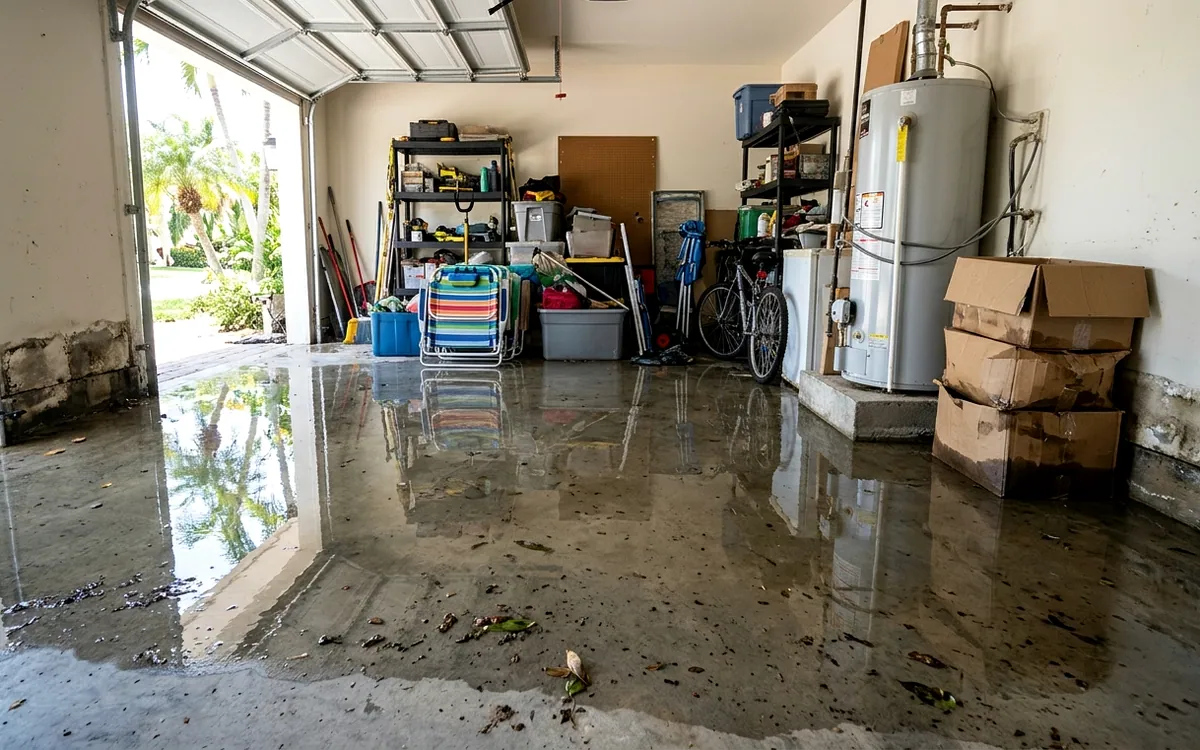
Garage floors in Florida homes are usually slab on grade, often a step lower than the house. Tidal water that reaches the garage can soak the bottom of drywall, stored cardboard boxes, a water heater platform and anything set directly on the floor. Water that sits there can also wick under the door into a laundry room or hallway.
Floodwater from outside is treated as Category 3 under the IICRC approach, because it runs across roads, yards and drains. In a coastal street it also carries salt. That means wet drywall and porous materials it touched are usually removed, not dried in place, and hard surfaces are cleaned and disinfected.
- Garage drywall wet along the bottom edge
- Soaked cardboard and stored items on the floor
- Salt residue on tools, bikes and appliances
- Water wicking under the door into the house
- Damp, musty smell in the garage after the tide drops
Steps to take before king tide season
Since king tides are predicted, you can plan for them like a calendar event. Check the tide predictions for your area each August and note the highest days. If your street floods, move cars to higher ground on those mornings so wakes and salt water stay away from them and your garage.
Inside the garage, get stored items off the floor and onto shelves. Plastic bins with lids hold up far better than cardboard. Make sure the bottom seal on the garage door is intact, and keep the door closed during high tide.
It is also worth checking your flood coverage. FEMA states that most standard homeowners policies do not cover flood damage, and an NFIP policy typically takes effect 30 days after purchase. In Miami-Dade, flood insurance is mandatory for federally backed mortgages in zones AE, AH, AO and VE.
- Mark the highest tide days from August through December
- Move cars off low streets on those mornings
- Put garage storage on shelves or in lidded plastic bins
- Replace a worn garage door bottom seal
- Keep a few sandbags or water barriers for low thresholds
What to do if tidal water gets in
Once the tide drops, photograph the water line, the wet floor and anything damaged before you clean. Wear boots and gloves, since the water is contaminated. Rinse salt and silt off hard surfaces, and move wet boxes and stored items outside. Do not run power tools or appliances that sat in salt water until they have been checked, and keep children and pets out until the floor is cleaned.
Check the bottom of the garage drywall and the wall between the garage and the house with a moisture meter, or call someone who has one. The EPA advises drying water-damaged areas within 24 to 48 hours to prevent mold growth, and Miami's humidity makes a closed garage slow to dry on its own.
If tidal or street water has reached your garage or living space, call us at (786) 947-0034, 24/7. We will measure what is wet, cut out and dry what needs it, and document the damage for your flood or homeowners claim.
Reader questions
Water only came into my garage, not the house. Does it still need attention?
Yes, if it soaked drywall, stored items or the wall shared with the house. Tidal water carries salt and contaminants, and a closed garage dries slowly in Miami humidity. A moisture check along the bottom of the walls tells you whether anything needs to be cut out.
Is king tide water in my garage covered by homeowners insurance?
Often not, since water rising from the street is generally treated as flood, and FEMA notes most standard homeowners policies do not cover flood. A separate flood policy may respond. Ask your agent about your own coverage and photograph the damage first.
How do I know which days the king tides will hit my street?
King tides are predicted from tide tables, so the highest days are known in advance. Local governments, including Coral Gables, publish predicted windows, which for 2026 run from August through late December. They tend to cluster around new and full moons, so check the times for your nearest tide station.
More guides from our crews
AC drain line leaks in Miami condos
In a Miami condo, the air conditioner runs most of the year and pulls gallons of water out of the air. When the small drain line that carries that wat
Read the guideCan wet drywall be saved after a leak?
Wet drywall does not always have to come out. Whether it can be dried in place depends on what kind of water soaked it, how long it has been wet, and
Read the guideThe first 24 hours after water damage at home
The first day after a leak or flood decides how much of your home can be dried and kept. These are the steps that matter most, in the order we would t
Read the guideWater where it should not be? Call now.
A person answers every call, day or night. Tell us what got wet and when it started, and we will tell you what happens next.