How long structural drying takes, and what sets the pace
Most people want one number: how many days the fans will run. The honest answer is a range, and it depends on how much water got in, what it soaked, and how fast the air in your home can carry it away.
Written from what our crews see on Miami jobs, for homeowners, condo owners and property managers.
At a glance
- Written by
- Winston Albright
- Role
- Guides Editor and Restoration Project Lead
- Updated
- November 2026
- Reading time
- 6 minutes
- Many clean-water jobs dry in about three to five days, but the meter, not the calendar, decides when drying is done.
- Water class describes the drying load, and higher classes need more equipment and more time.
- Hardwood, plaster, block and concrete slabs hold water deep inside and take the longest.
- Daily moisture readings at marked points are the clearest way to see that a job is on track.
The short answer, with the conditions attached
For a typical clean-water leak caught early, with wet drywall, baseboards and a section of floor, drying often takes about three to five days. A small leak that only wet the surface of one room can finish sooner. A large loss with wet ceilings, insulation and subfloor, or dense materials like hardwood and concrete, can take a week or longer.
Those figures assume the source has been fixed, the equipment is sized to the space, and the AC is working. Drying is not a fixed schedule. It ends when the materials reach a dry standard on the meter, not when a certain number of days has passed.
That is why we never promise a finish date on the first visit. We give you an expected range, then let the daily readings show whether the job is on track.
Speed at the start matters as much as anything that happens later. The EPA advises drying water-damaged areas within 24 to 48 hours to prevent mold growth, and a job that starts late is simply a harder job. Water that sat for two days has had time to wick higher up the walls, soak deeper into wood and spread under more flooring, so the drying load is simply bigger.
How water class changes the timeline
The IICRC S500 water damage standard sorts jobs by class, which describes how much water is present and how fast it is expected to evaporate. Class is different from category: category is about contamination, class is about the amount of water and the drying load.
The class sets how much equipment the job needs on day one and gives a fair sense of how long it will run. The higher the class, the more water has to leave the structure, and the more of it sits in places where air moves slowly.
- Class 1: the least water, part of a room or materials that absorbed little moisture.
- Class 2: at least a full room of wet carpet and pad, with water wicking less than 24 inches up the walls.
- Class 3: the most water, often from overhead, with ceilings, walls, insulation, carpet and subfloor saturated.
- Class 4: specialty drying for hardwood, plaster, brick, concrete and stone, which hold water tightly.
Materials that dry slowly
Drywall and carpet give up water fairly quickly once air moves across them. Denser materials take much longer. Hardwood floors, plaster, concrete block walls and the slab under your flooring hold water deep inside, and that moisture has to travel out to the surface before air can take it away.
Miami homes have a lot of these slow materials. Florida homes are usually built on concrete slabs because of the high water table and porous limestone ground, and many local houses from the 1940s through the 1960s are concrete block and stucco. Terrazzo, common in mid-century homes, also sits on the slab.
Layers slow things down too. Tile over a wet slab, vinyl plank over underlayment, or cabinets set against a wet wall all trap water. Sometimes the faster path is to remove a toe kick, drill small holes behind baseboards, or lift a few planks so air can reach the wet layer.
When a material cannot be dried in place within a reasonable time, removing it is often cheaper than running equipment for another week. The EPA advises discarding wet insulation and swollen wallboard that cannot be dried within 48 hours, so a flood cut at the bottom of a wall can shorten the whole job.
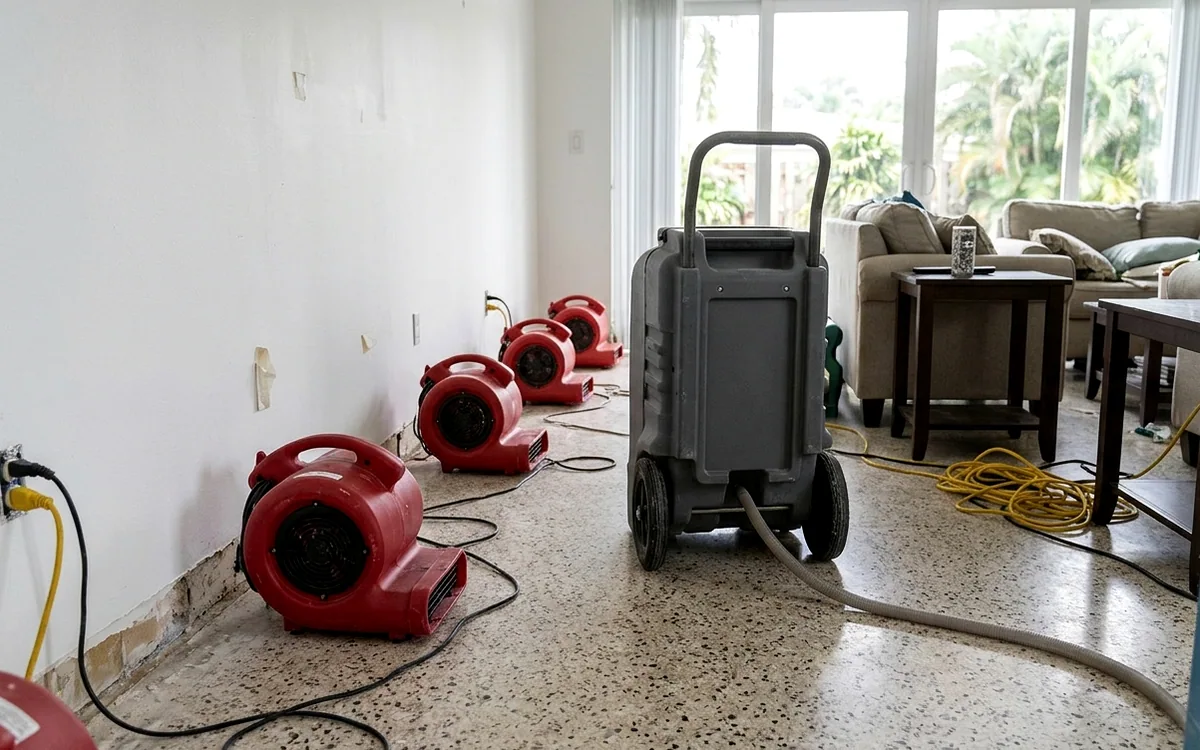
Why Miami air works against you
Drying is a contest between wet materials and the air around them. Dry air pulls water out of drywall and wood. Damp air has little room left to take more. Miami's average morning relative humidity is about 82 percent across the year, so outdoor air rarely helps.
That is why opening windows usually makes drying slower here, not faster. The job is set up as a closed drying chamber: doors and windows shut, the AC running, and dehumidifiers pulling water out of the air so the air movers can keep pulling it out of the materials.
The CDC recommends keeping indoor humidity at or below 50 percent, and the dehumidifiers on a drying job usually push the room well below that level while the structure dries.
Season makes a difference as well. The National Weather Service puts the South Florida wet season at May 15 to October 15, when dew points in the 70s are an almost daily occurrence. A summer job often needs an extra dehumidifier compared with the same leak in January, which is normally Miami's driest month. Equipment is added or moved based on the readings, not left in one spot for the whole job.
A working AC helps a great deal, because it removes moisture on its own. If the AC is the source of the leak, or it is down, plan on drying taking longer until it is running again.
What the daily readings tell you
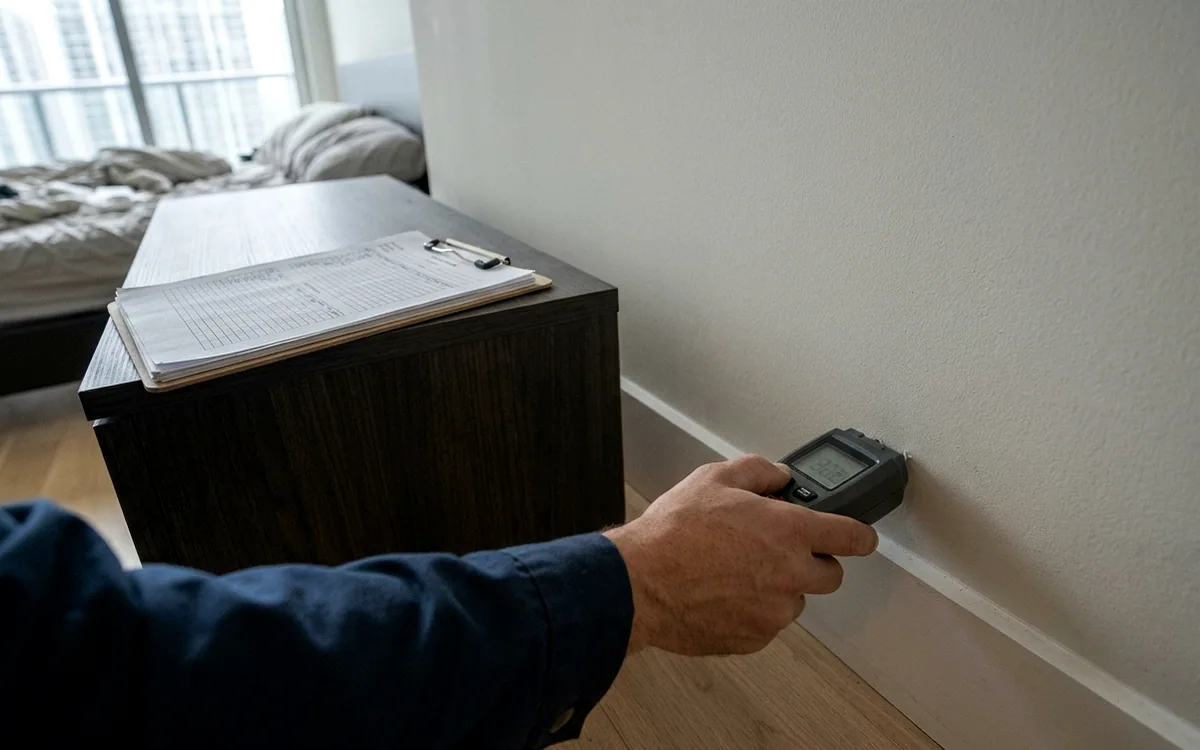
On a properly run drying job, someone takes readings every day and writes them down. Those readings are the only real measure of progress, and they are worth asking to see.
Each reading point is marked on a moisture map so the same spot is checked each day. A good log shows numbers falling steadily toward the dry standard, which is usually set by a reading taken on the same material in a part of the home that never got wet. If one spot stalls, that tells us the water has a hidden path, a material needs to be opened up, or the equipment needs to move.
These logs also help with an insurance claim. They show the adjuster why equipment ran for the number of days it did and when the structure reached dry.
- Moisture content of drywall, wood and other materials at marked points
- Temperature and relative humidity in the drying area
- Readings from unaffected rooms for comparison
- Dehumidifier output and placement of air movers
- Notes on any material opened up or removed
What can stretch a drying job
The most common delay is a source that was not fully fixed. A slow drip from a supply line or a weeping AC pan keeps feeding water into the wall, and the readings never drop. The second is a wet layer that air cannot reach, like a sealed cabinet base or a vapor barrier behind a wall.
Turning equipment off at night to save noise or power also adds days, because drying stops the moment air stops moving. So does a home that gets too cool. Very low temperatures slow evaporation, so the AC should be set to a normal comfortable range rather than as cold as it goes.
If you are worried your drying job is dragging, or no one has shown you a reading, call us at (786) 947-0034, 24/7. We can take a set of readings and tell you plainly what is still wet and why.
Reader questions
Can I turn the fans off at night so we can sleep?
It is better not to. Drying stops when air stops moving, so every night the equipment sits off adds time to the job. If the noise is a problem in a bedroom, ask whether a fan can be repositioned or the door closed while the rest keeps running.
The wall feels dry to the touch. Why is the equipment still here?
Drywall surfaces dry first, while the bottom edge, the studs and the slab behind it can still be wet. The meter reads moisture below the surface. Equipment comes out when those readings match a dry reference spot, not when the surface feels dry.
Should I open the windows to help the house dry faster?
In Miami, usually no. Outdoor air is often humid enough to slow drying or even add moisture. Keeping windows and doors closed lets the dehumidifiers pull water out of the air so the materials keep giving it up.
More guides from our crews
AC drain line leaks in Miami condos
In a Miami condo, the air conditioner runs most of the year and pulls gallons of water out of the air. When the small drain line that carries that wat
Read the guideCan wet drywall be saved after a leak?
Wet drywall does not always have to come out. Whether it can be dried in place depends on what kind of water soaked it, how long it has been wet, and
Read the guideThe first 24 hours after water damage at home
The first day after a leak or flood decides how much of your home can be dried and kept. These are the steps that matter most, in the order we would t
Read the guideWater where it should not be? Call now.
A person answers every call, day or night. Tell us what got wet and when it started, and we will tell you what happens next.