How fast mold grows after water damage in a Miami home
After a leak, the question is rarely whether mold could grow. It is whether the wet materials dry before it does, and in Miami the margin is thin.
Written from what our crews see on Miami jobs, for homeowners, condo owners and property managers.
At a glance
- Written by
- Winston Albright
- Role
- Guides Editor and Restoration Project Lead
- Updated
- November 2026
- Reading time
- 6 minutes
- The EPA and CDC both advise drying wet areas within 24 to 48 hours to prevent mold growth.
- Drywall, carpet pad, cardboard and cabinet bases are usually the first places mold grows after a leak.
- Miami's high humidity slows natural drying, so wet materials stay wet longer here.
- Keeping indoor humidity at or below 50 percent and fixing the moisture source are what stop mold.
The 24 to 48 hour window
Both the EPA and the CDC point to the same window: dry water-damaged areas and items within 24 to 48 hours to prevent mold growth. That is not a promise that mold appears at hour 49. It is the point where the risk climbs sharply if materials are still wet.
Mold spores are already present in nearly every home, floating in the air and settling on surfaces. They do nothing until they find moisture and something to feed on. The EPA puts it simply: the key to mold control is moisture control, because mold cannot grow without moisture.
So the clock starts when materials get wet, not when you notice the stain. A slow leak behind a vanity or under a dishwasher may have been feeding a wall for weeks before the first sign shows.
Category matters here as well. Water from a sewage backup or street flooding brings its own load of organic material, which gives mold more to feed on. Category 2 water left untreated for more than about 48 hours can degrade to Category 3, so dirty water and slow response tend to make each other worse.
What mold grows on first
Mold needs food, and most homes are full of it. The CDC notes that mold can grow on paper, cardboard, ceiling tiles, wood, drywall, insulation, carpet, fabric and upholstery. Anything made from plant fibers or holding dust and organic residue is a candidate.
Drywall is usually first in line after a leak. The paper facing on both sides soaks up water and holds it, and the back side faces a dark, still wall cavity where no one sees it. Carpet pad, cardboard boxes in closets and the particleboard bottoms of kitchen and bathroom cabinets are close behind.
Hard, non-porous surfaces such as tile, glass, metal and sealed concrete do not feed mold well on their own, though dust and soap film on them can. Those surfaces can usually be cleaned. Porous materials that have grown mold are often removed instead.
- Drywall paper facing, especially the back side
- Carpet pad and the tack strip under it
- Cardboard boxes and paper stored on closet floors
- Particleboard cabinet bases under sinks
- Ceiling tiles and attic insulation
- Upholstered furniture and fabric
Why Miami humidity speeds things up
In a dry climate, a damp wall can start drying on its own once the leak stops. In Miami, the air is often too damp to take much more water. Average relative humidity runs about 82 percent in the morning and 61 percent in the afternoon across the year, with August mornings averaging about 83 percent.
The National Weather Service notes that dew points in the 70s are an almost daily occurrence during the wet season, which runs from May 15 to October 15. With air that moist, wet materials lose water slowly, and surfaces that were never directly wet can still pick up enough moisture to support growth.
That is why a leak that might dry out unnoticed in another city often turns into a musty closet or a spotted baseboard here. Warm temperatures add to it. Miami's average daily high heat index is about 100 degrees F in August, and a home with the AC off during a power outage warms up fast.
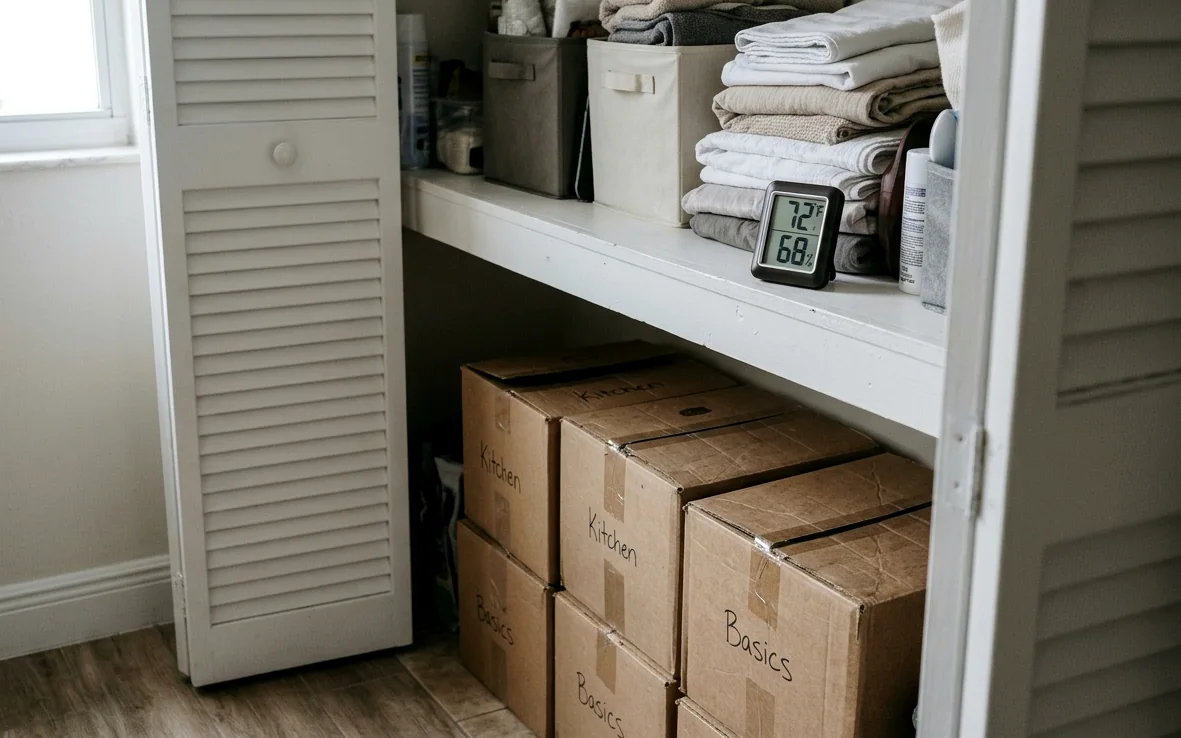
Keeping indoor humidity at or below 50 percent
The CDC recommends keeping indoor humidity at or below 50 percent. The EPA advises keeping it below 60 percent, ideally between 30 and 50 percent. A simple digital hygrometer, available at most hardware stores, shows you where your home stands.
Your AC does most of this work in a Miami home, because it removes moisture as it cools. When the AC is oversized, set too high, or short-cycling, it cools the air without running long enough to dry it, and indoor humidity creeps up. A clogged condensate line has the same effect.
After water damage, the drying setup pushes humidity well below that range in the affected rooms until the materials read dry. For homes that stay damp year round even without a leak, a whole-home dehumidifier tied into the AC system can hold humidity in range.
- Check a hygrometer in the bedroom, closets and laundry room
- Keep the AC running when you travel instead of shutting it off
- Run bathroom exhaust fans during and after showers
- Keep closet doors open now and then so air can move
- Fix any dripping condensate line or overflowing pan right away
Signs mold has already started
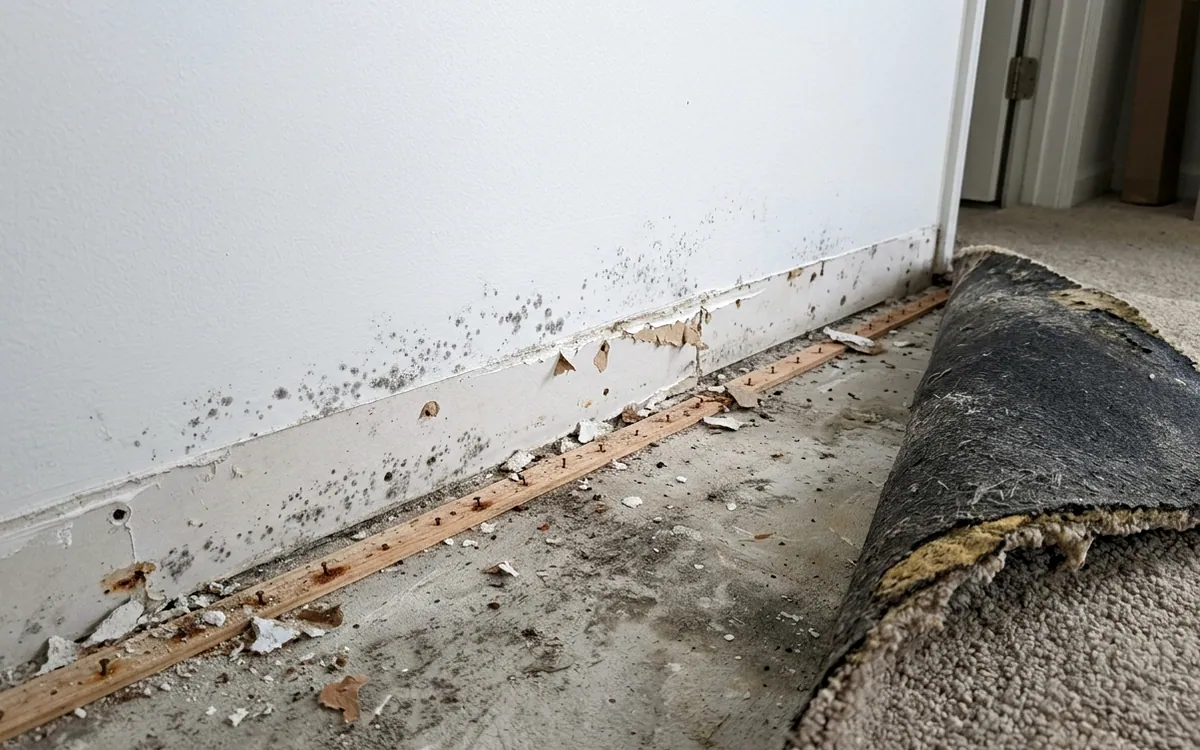
Early growth is often hidden. The first clue is usually smell: a damp, earthy or musty odor that is stronger in one room, one closet or one cabinet. You may also see small gray, green or black spots on the bottom of drywall, the back of a baseboard, or the underside of a sink cabinet floor.
Paint that bubbles or peels near the floor, baseboards that swell or pull away from the wall, and carpet that stays damp at one edge all point to moisture that has been there a while. The CDC notes that some people react to mold with a stuffy nose, sore throat, coughing or wheezing, itchy eyes or a skin rash, and that people with asthma, allergies or weakened immune systems can react more strongly.
If you notice these signs in a room that had a leak, the area needs a closer look, even if the visible spot is small.
When to handle it yourself and when to call
The EPA says most people can clean a moldy area of less than about 10 square feet, roughly 3 feet by 3 feet, themselves. Larger areas, or growth tied to significant water damage, call for more thorough remediation. Florida's mold law uses the same 10 square foot line to define mold assessment and remediation work.
Whatever the size, cleaning mold without fixing the water problem usually lets it come back, according to the EPA. Moldy surfaces should not be painted or caulked until they are cleaned and dry. Finding the moisture source is the real job, and the visible growth is just the symptom.
If a leak has soaked your home in the last day or two, the best way to deal with mold is to keep it from starting. Call us at (786) 947-0034, 24/7, and we will measure what is wet and start drying it. If mold is already visible, we can inspect to find how far it goes and what is feeding it.
Reader questions
The leak was three days ago and I do not see mold. Am I in the clear?
Not necessarily. Growth often starts on the back of drywall, under pad or inside cabinet bases where you cannot see it. A moisture meter check tells you whether those materials are still wet, which is the real risk. If they read dry, the odds are much better.
Will bleach on the stain stop mold from growing?
Bleach on the surface does little if the material underneath is still wet, and it does not reach the back side of drywall. The EPA says cleaning mold without fixing the water problem usually lets it come back. Drying the material and fixing the source come first.
Does running the AC colder help prevent mold after a leak?
Keeping the AC running helps because it removes moisture from the air. Setting it extremely cold is not needed and can slow evaporation from wet materials. A normal comfortable setting plus a dehumidifier in the wet area works better than turning the thermostat way down.
More guides from our crews
AC drain line leaks in Miami condos
In a Miami condo, the air conditioner runs most of the year and pulls gallons of water out of the air. When the small drain line that carries that wat
Read the guideCan wet drywall be saved after a leak?
Wet drywall does not always have to come out. Whether it can be dried in place depends on what kind of water soaked it, how long it has been wet, and
Read the guideThe first 24 hours after water damage at home
The first day after a leak or flood decides how much of your home can be dried and kept. These are the steps that matter most, in the order we would t
Read the guideWater where it should not be? Call now.
A person answers every call, day or night. Tell us what got wet and when it started, and we will tell you what happens next.